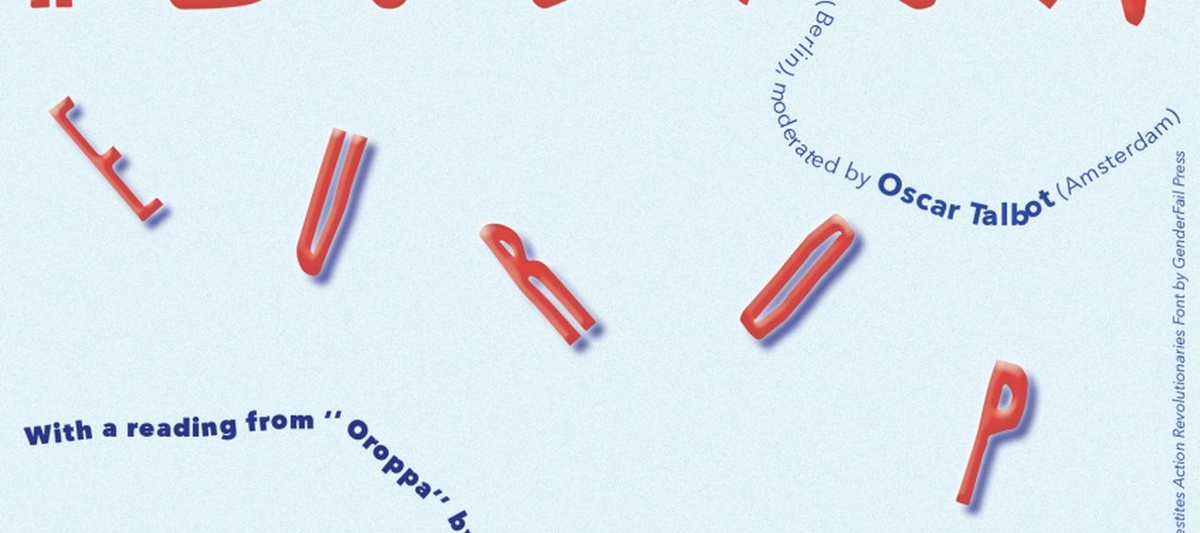
Abolish Europe
“Europe is indefensible”, writes the anticolonial thinker Aimé Césaire already in 1950. A civilization that has practiced, witnessed and justified colonialism and genocide, he argued, would inevitably develop forms of indifference, ignorance and coldness towards human life that allows the most extreme forms of violence and neglect to emerge and to flourish. The manifold forms of brutality we currently observe can thus be seen as the direct consequences of the very concept of “Europe“. What might abolition mean in, for and against Europe?
Abolitionism, as a distinct approach in critical theory and political activism, is often associated with the abolition of slavery in the Americas. Contemporary movements such as police and prison abolitionism are also marked by debates centered on the US. This event asks what abolition might mean in, for and against Europe; its own specific genealogies, articulations and conjunctures of legal and extralegal violence – border regime, militarism, ecological destruction, exploitation and super-exploitation – and its own histories, traditions and coalitions of resistance and living otherwise.
We have invited writers, scholars and activists to discuss the question of what abolition means, has meant and might mean in Europe.
Speakers
Deanna Dadusc is Senior Lecturer at the University of Brighton. She examines the criminalization of migration and solidarity by the European border regime.
Akwugo Emejulu is a professor of sociology at the University of Sheffield and the author of Fugitive Feminism (London 2022), amongst other books. She works on the history and presence of Black feminist organizing in Europe.
Simin Jawabreh is a political scientist and activist, living and organizing in Berlin. She explores how marginalized communities manage to create safety from below.
Safae el Khannoussi is a writer and a member of the “Abolition Democracies” research project. She will read from the English translation of her critically acclaimed novel Oroppa.
Oscar Talbot is a philosopher, activist, and a member of the “Abolition Democracies” research project. He will moderate the evening.
This conversation concludes the 4-year research project “Abolition Democracies – Transnational Perspectives” at the University of Amsterdam, funded by the Gerda Henkel Foundation.