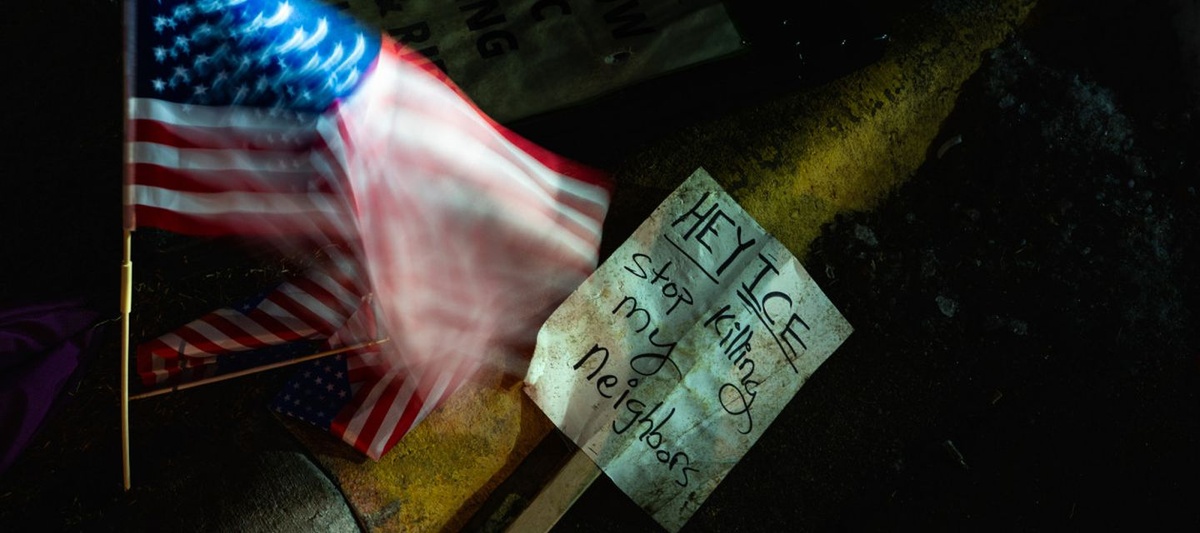
A Slippery Slope: ICE and the normalization of harm

The ICE raids gripping the US are shocking. Across the country, immigrants (and those who look like them) are being villainized, brutally detained, and deported. The US government shows no signs of slowing down. Their narrative, that migrants form an existential threat to the United States which needs to be removed, has erupted mass outrage, protests and other forms of resistance. This blatant violence forces us to confront how we arrived at this moment, how systems come to normalize harm against marginalized communities, and how legal institutions and media narratives produce the deadly consequences we see today.
This panel uses the most recent ICE raids as a case study to analyze how state-inflicted violence on marginalized communities comes to be normalized. By bringing together perspectives from human rights, international law, photojournalism, and activism, this discussion will examine how institutions like the media shape our perceptions of violence, responsibility, and human worth. From the legal logics that make enforcement appear reasonable or necessary to the narratives that decide whose suffering becomes visible and how, this panel challenges the idea that the events unfolding in the United States are exceptional. Instead, it aims to address a broader question that is becoming increasingly urgent: how is state-sanctioned violence made acceptable, and what can we do to challenge it?
Speakers
Santino Salvador Regilme is a tenured Associate Professor and Program Chair of International Relations based at the Institute of History at Leiden University, the Netherlands. He is the author of Aid Imperium: United States Foreign Policy and Human Rights in Post-Cold War Southeast Asia (University of Michigan Press, 2021), which received several accolades. His most recent monograph is United States and Chinese Foreign Assistance and Diplomacy: Aid for Dominance (Manchester University Press, 2026, coauthored with Obert Hodzi). His expertise has been featured in CNN International, Al Jazeera, Deutsche Welle, and many other media outlets.
Wouter Werner is professor of international law at the Centre for the Politics of Transnational Law at the Vrije Universiteit, Amsterdam. In 2022 he finished his project on practices of repetition in international law, with a focus on restatements, moot courts and cinematic representations of international law. This resulted in the book “Repetition and International Law”, published by Cambridge University Press. His current research focuses on the notion of the absurd in international law, the evolution of customary law and re-enactment practices in international law.
Pierre Lavie is a Swiss-American, Dallas, TX based documentary photographer/photojournalist. He’s been documenting communities, protests, and (as of late) ICE activity across the U.S. for the past seven years. He’s also spent time documenting communities in Cuba, Kurdistan, and Mexico. Pierre has been married for 22yrs to his wife, Katie, and they enjoy raising and spending time with their two teenagers, dog, nine cats, and tortoise. Pierre strives for his work to have tangible impact for the communities he documents and so he will soon be launching his website that will sell select prints via a 90/10 split in support of those communities. You can follow his work on Instagram @just1dudewithacamera. #ICEout #NoWar #FreePalestine #SayTheirNames-Good&Pretti
Else Lanjouw is an editorial member of SPUI25 in Spe. I have always been fascinated by the versatility of human beings. We can show so much love and compassion, and at the same time so much cruelty and neglect. For this reason, I studied Political Science at the University of Amsterdam, after which I completed a master’s degree in Global Conflict in the Modern Era in Leiden. My interest continues to lie in humanizing political science issues. How can we maintain empathy in dehumanizing situations, such as conflict and forced displacement? At SPUI25 in Spe, I hope to explore the different sides of human behavior and thus discover ways to combat dehumanization and violence.