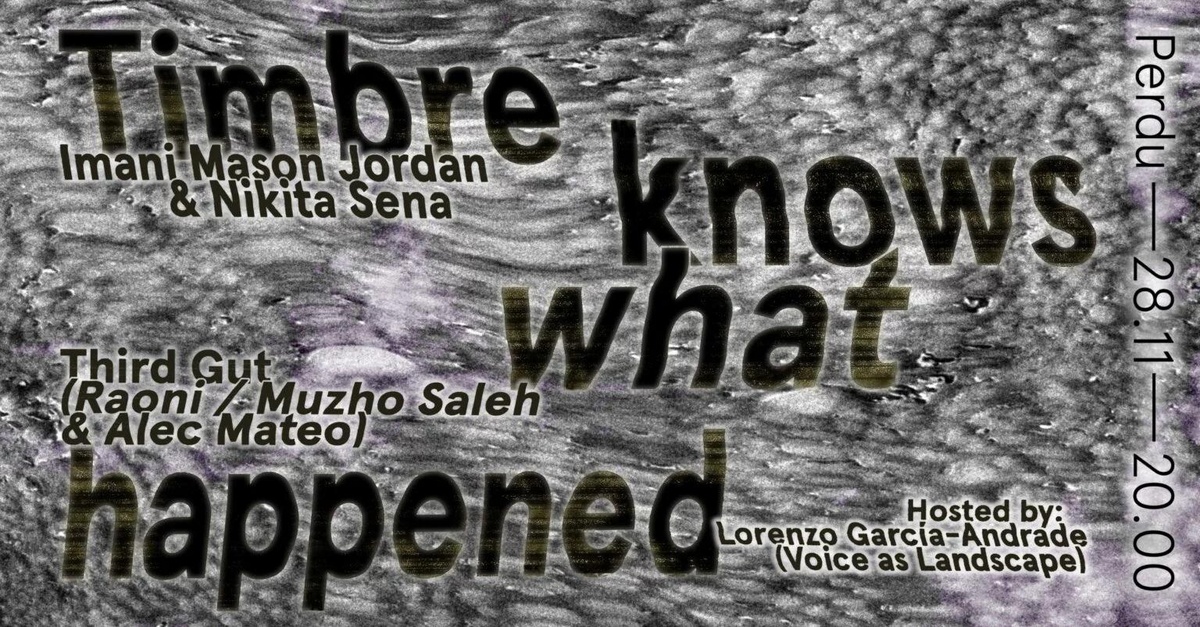
Timbre knows what happened
With Imani Mason Jordan and Nikita Sena; and Third Gut (Raoni / Muzho Saleh and Alec Mateo).
Timbre knows what happened. It does. Voices are containers and content at the same time. Voice is ship and load. This evening, the second in Voice as Landscape‘s new focus on song, is dedicated to exploring the voice as an instrument through two artistic collaborations that propose diverse approaches to this.
Voice is an instrument made of flesh and air. One that is sentient, that remembers, that is haunted. A glass of water now can clear a voice but a voice is ultimately an aftermath—of that body’s life and others that preceded it.
It is also a resource we have, one that moves through different emotional spectrums and layers of knowledge. As a resource it is one we can save, we can lend and we can of course instrumentalize to put forth in sound own ideas of world. Both proposals of the evening explore meaning and poetics of voicings beyond language.
Imani Mason Jordan and Nikita Sena will be visiting from Italy and the UK, respectively. Together they have been exploring the potentials of sound matter found in text and language beyond its literality. In their procedures they incorporate repetition, improvisation and archive to distort preconceived forms of meanings but also produce new ones that resignify established structures of sense.
This evening will be the first public offering of Third Gut. Third Gut is where Raoni / Muzho Saleh‘s and Alec Mateo’s practices meet. A space for them to explore transformative sounding, built on noise, vocality, performance and sacred mourning traditions. Raoni, drawing from the Shia mourning tradition, works with the wail as an embodied expression of grief, that carries in it emancipatory potentials and political urgencies, and Alec works with sound as a way to negotiate a fugitive relationship to memory, world, and subject building.
Imani Mason Jordan is an interdisciplinary writer, artist, editor and curator interested in poetics and performance. Imani has written numerous articles, reviews, essays, poems, plays and love letters, some of which they have published. Since 2016, they have developed a keen interest in poetics, oration, experimentation and practices of reading aloud, from which they have synthesised a performance practice that centres writing and collaboration as well as using the speaking voice as an instrument. After completing their MA in Forensic Architecture at Goldsmiths in 2019, their pamphlet OBJECTS WHO TESTIFY was published by Taylor Le Melle at PSS. Imani is also Director of PAPERFLESH PUBLISHING, a multi-genre small press and editing studio for the intellectually rigorous, politically-minded black writer. Since 2019, Imani has collaborated extensively with Rabz Lansiquot as part of the artistic and curatorial duo Languid Hands.
Nikita Sena is a curator, writer and researcher from London, by way of Ghana. Her practice is informed by experimental pedagogies and the connection between aesthetic forms and their socio-political implications. Nikita is currently rifling through notions of ephemerality and abjection, discomfort, inappropriateness and desire. A former curatorial fellow on the New Curators programme, Nikita is now part of the curatorial team working on the Kerry James Marshall exhibition at the Royal Academy of Arts.
Third Gut is an experimental sonic performance project between Raoni/Muzho Saleh and Alec Mateo, who, in their noisy bemoaned togetherness form a psycho-somatic space for undergoing the alchemical. A sonic tissue that lures the collective into the muddy waters of discomfort, where becoming disturbed reveals a desired futurity. It is through the generative force of noise as sound, that Third Gut aims to undo the brutality which masks as enlightened civility.
Raoni/Muzho Saleh (1991 AFG/NL) is an artist with a bachelor‘s degree in Literary and Cultural Analysis (UvA) and a bachelor’s degree in Choreography (SNDO). Their work is influenced by fugitivity, a revolutionary movement that shapes his artistic vision. By dancing through the gender spectrum, Raoni has developed a unique movement practice that emphasises becoming “other” and choreographing a continuous state of incompleteness. Through the use of materials such as fabrics, textile, dough, voice and text, Raoni invites a serious kind of play into the space where both spectators and performers can become immersed in otherworldly narratives. His intimate relationship with the materiality of artistic practice allows for an ongoing negotiation of a wayward becoming.
Alec Mateo is a Dominican artist from New York working with language, sound, and performance to explore the potentials of fugitivity; an attempt to negotiate the relationships between narrative and subject.