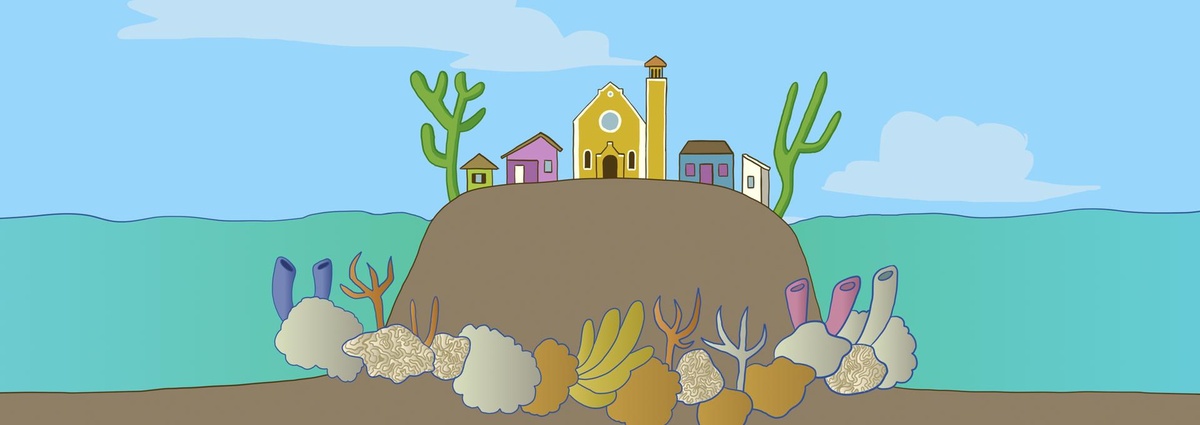
How to care for Bonaire?

On Wednesday, January 28, judges in The Hague sided with residents of Bonaire and Greenpeace in the Bonaire lawsuit against the Dutch government. In this landmark case, residents of Bonaire – together with Greenpeace – made the case for meaningful climate action: faster reductions in CO2 emissions and fair protection against the impacts of the climate crisis. Protection that current Dutch climate policy so far has failed to provide. In this programme, we will reflect on what the lawsuit means in practice. The evening centres around the launch of the new video ‘How to Care for Bonaire’ by Prof Poldergeist which exposes the absence of climate justice for Bonaire, and shows why the current Dutch climate adaptation framework falls short. Following the screening of the video, we will continue the conversation with experts and knowledge holders to highlight the discrepancy between how climate adaptation is currently imagined in the European Netherlands and how island communities themselves envision their future. It therefore offers policymakers and audiences in the European Netherlands a clearer understanding of the lived realities on the island and of why urgent policy change is needed to ensure climate justice across the Kingdom.
In conversation with Simon Richter Professor at University of Pennsylvania, and 'Professor Poldergeist' on YouTube Lysanne Charles PhD Political Anthropology focusing on Governance, Climate Change, Policy Development and Community Engagement; Caribbeanist, Feminist & Womanist Maarten de Zeeuw Climate expert and project lead of the Bonaire climate case at Greenpeace Netherlands Radinka Ustasia Director of Maanarak of Grey B.V., a Bonaire-based social enterprise Bertram de Rooij Landschapsarchitect, Wageningen Environmental ResearchAbout the panelists
Professor Simon Richter (Professor Poldergeist) is Professor of German and Environmental Humanities, explores climate justice through cultural and historical lenses. His work on Dutch Caribbean islands, including Bonaire, examines how colonial legacies and environmental policies intersect with local resilience and global climate equity, advocating for inclusive, community-driven solutions. For more on his project Professor Poldergeist, see below.
Lysanne Charles investigates the social and political dimensions of climate justice in the Caribbean. Her research on Bonaire highlights how marginalized communities navigate climate change, resource extraction, and governance gaps, emphasizing the need for equitable policies that center local knowledge and autonomy in climate adaptation.
Maarten de Zeeuw leads Greenpeace’s landmark climate litigation on Bonaire, challenging industrial pollution and advocating for the island’s right to a healthy environment. His work bridges legal action, community empowerment, and systemic change to address climate injustice and protect Bonaire’s ecosystems and residents.
Radinka Ustasia drives Maanarak of Grey, a Bonaire-based social enterprise promoting sustainable land use and climate resilience. Her initiatives empower local communities to combat desertification, water scarcity, and climate impacts, fostering economic and ecological justice through regenerative practices and education.
Bertram de Rooij designs climate-adaptive landscapes, with a focus on Bonaire’s vulnerable ecosystems. His work integrates traditional knowledge and innovative solutions to restore biodiversity, mitigate climate risks, and ensure equitable access to green spaces, supporting both people and nature in the face of climate change.
Read more Professor PoldergeistDr Poldergeist is the alter ego of Simon Richter, Class of 1965 Endowed Term Professor of Germanic Studies at the University of Pennsylvania. Simon's research focuses on cultural aspects of climate adaptation in Germany, Indonesia, the Netherlands, and the United States. As an environmental humanist, Simon engages in activities that blur distinctions between traditional scholarship, urban design, and environmental activism. Simon and Poldergeist are featured in the VPRO documentary "De Klimaatverkenner" (2022). In 2023, he collaborated with Dutch comedian Patrick Nederkoorn to produce "A New Peace of Münster," a documentary about climate migration along the Dutch-German border. Project Poldergeist is an experiment in storytelling, creative reflection, intercultural awareness, and collaboration. With Penn fine arts prof Joshua Mosley, Simon co-directs the Penn Animation as Research Lab.
What is at stake for Bonaire?Earlier this year, a Dutch court ruled that the Netherlands must do more to protect Bonaire from the impacts of climate change. The case, brought by residents of the island together with Greenpeace Netherlands, argued that the Dutch government had failed to adequately safeguard one of its own municipalities against rising climate risks.