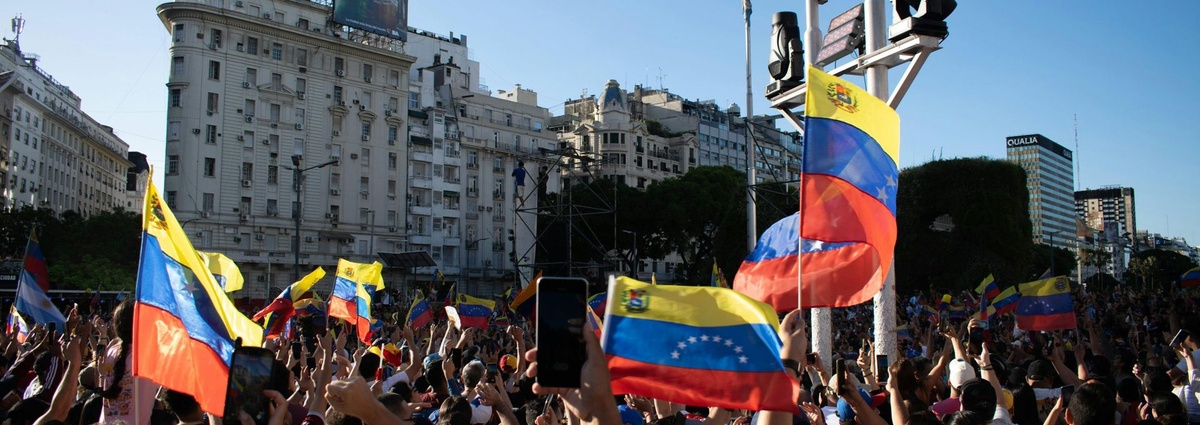
Venezuela after Maduro
The removal of Nicolás Maduro marks a critical juncture for Venezuela. What happens next? Who will have the legitimacy to rebuild the country’s institutions, and what kind of society will emerge? The voices of the Venezuelan people must lead this process, because a just society is founded on democracy, the protection of human rights, and the rejection of political repression, violence, and abuse of power. Together with leading Venezuelan democratic actors, we examine the realities on the ground and the long road toward democratic reconstruction.
Together with Daniel Picado Sarmiento Founder País Plural Sairam R. Rivas Co-founder of the Committee of Families for the Freedom of Political Prisoners in Venezuela. Victoria Capriles Venezuelan Pracademic Expert in Migration and Gender, Human Rights Lawyer and Visiting Fellow at the T.M.C Asser Institute. Suleyman Aslami Gemeenteraadslid D66 AmsterdamMore about the programme
This panel brings together leading Venezuelan democratic actors to examine the realities on the ground and the long road toward democratic reconstruction. Drawing on lived experience and long-standing human rights work, speakers will explore the risks and possibilities of political transition, the role of civil society and youth, and how accountability, memory and justice must shape Venezuela’s future.
Moving beyond simplified geopolitical framings, the discussion asks what a democratic transition could realistically look like, and who gets to shape it, after years of repression, mass displacement and institutional collapse. Furthermore, it explores what the role of the international community is and what is the role that governments like the Dutch can play in helping the panelists and other Venezuelan activists to fight for rights and freedom in their country.
This event offers a rare opportunity to hear directly from Human Rights Defenders and civil society leaders navigating one of the most consequential political moments in Venezuela’s history. These panelists are current and former guests of the Shelter City Programme Netherlands which provides temporary relocation to activists facing serious threats. They arrived feeling the rush of arrest and persecution, seeking safety while strengthening their expertise, expanding their networks, and building alliances to support democratic change. In light of recent developments in Venezuela, their return home has become uncertain.
Speakers’ bios:
Daniel Picado
Daniel Picado is a Venezuelan epidemiologist and human rights defender with extensive experience in international cooperation and public policy advising. He is the former director of País Plural, a youth-led LGBTQI+ organisation in Venezuela dedicated to research, advocacy, and capacity-building for young activists. Under his leadership, País Plural became the country’s largest LGBTQI+ organisation, with projects supported by the United Nations and the Dutch, French, and German embassies. Its initiatives range from using queer art as a tool for social dialogue to developing academic diploma programmes in collaboration with leading Venezuelan universities. Due to persecution of human rights defenders during the 2024 elections, Daniel has been unable to return to Venezuela.
Sairam Rivas
Sairam Rivas is a Venezuelan activist and former student leader at the Central University of Venezuela, where she led the Social Work student centre. During the 2014 protests, she founded a student encampment and was subsequently arrested and detained for over four months in El Helicoide, a high-security detention centre notorious for systemic torture and human rights violations against political prisoners.
Victoria Capriles
Victoria Capriles is a Venezuelan pracademic specialising in migration, gender, and human trafficking. She is currently a visiting fellow at the T.M.C. Asser Institute, supported by Shelter City, and has experience in strategic litigation and advocacy within Inter-American and Universal human rights systems. Having practised law in Venezuela, she has also revalidated her legal qualifications in Mexico. With over seven years’ experience as a university professor focusing on migration, refugee issues, and women’s rights, her expertise is recognised through interviews with Venezuelan and international media outlets. She has published extensively, including peer-reviewed articles, opinion pieces, and book chapters, with a recent contribution to a Routledge volume. She has coordinated three books addressing the Venezuelan migration crisis, gender-based violence, and access to justice for vulnerable groups, and has presented research at institutions including Stanford University. Professor Capriles holds a law degree from Universidad Metropolitana, an MA in Sociology of Law from the Oñati International Institute for the Sociology of Law, and an MA in Political and Government Studies from Universidad Metropolitana. She has completed advanced studies in International Refugee Law from SUDIMER-UNAM and is currently pursuing a PhD in Political Science at Simón Bolívar University.