Up in Arms
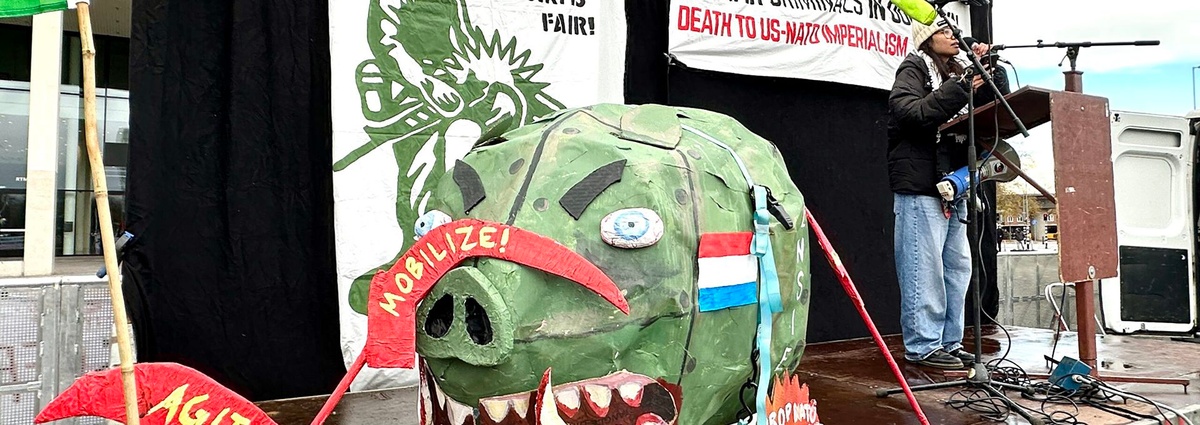
Following the publishing of the article ‘Up in Arms’, the three partners (Platform Beeldende Kunst, Alina Lupu and Jacobin NL) are organising a public event to bring the topic of artwashing and militarisation into the physical public realm. This event brings together writers, academics, artists and artist collectives in a bi-lingual (Dutch and English) symposium programme, with the option to dine together beforehand at 18:00. Together, we explore the resurgence of artist initiatives that refuse to remain neutral, while examining the politics of cultural exchange and state budget cuts. We review and assess the different strategies of dialogue, interventions and refusals that the symposium participants have been engaged in. What have we achieved and what are the new frontlines we are facing?
Joined by writers, academics, artists and artist collectives, this symposium also offers a vegetarian community dinner for €17,50 with your free seat reservation. You can choose this option by registering for this event! The dinner will start at 18:00.
As Dutch defense spending reaches unprecedented highs and artistic freedom narrows under political pressure, the question is no longer whether artists can stay neutral, but whether neutrality itself sustains violence. While Europe is re-arming itself in the face of new geopolitical tensions, the Netherlands has quietly shifted billions from cultural and social budgets into defense spending. Artists, educators and cultural workers find themselves again among those most affected by austerity.
Parts of the cultural sector have also become complicit, from state-funded cultural diplomacy to exhibitions and partnerships that sanitise or normalise militarisation. How are artists and institutions in the Dutch visual arts scene entangled with the expanding military-industrial logic? How do cultural programmes, exhibitions and the general visual arts discourse participate, knowingly or not, in ‘art-washing’ state militarism? What can history teach us from earlier moments when artists were mobilised in the service of the state? What tools of resistance still exist when refusal itself becomes criminalised?
In this programme Alina Lupu Post-conceptual artist en bestuurslid van Platform Beeldende Kunst Wendela de Vries Stop Wapenhandel, Netherlands, research and campaigns against arms trade and military industry Dewi Sofia Research assistant Framer Framed Anika Schwarzlose Artist, researcher, lecturer Sarjon Azouz Multidisciplinary artist Sruti Bala Associate Professor Theatre and Performance Studies, University of AmsterdamAbout the speakers
Alina Lupu is a Romanian-born, Dutch based writer and post-conceptual artist. She looks at the role that images and performative actions have when standing in solidarity through protest against capitalist hegemony and precarity. Here protest has a quite broad definition for her: from acts of civil disobedience, to petitions, debates, and building of counter-capitalist structures of care, creating a series of dialogues on alternatives to exploitative systems. She is also a board member of Platform BK.
Wendela de Vries is a political scientist and long-time researcher into arms trade, arms production and militarisation. She published dozens of articles on military industry and on arms export control. As a researcher-activist she is co-founder and coordinator of Stop Wapenhandel, the Dutch Campaign Against Arms Trade. She also initiated and moderates the working group on Arms, Militarisation and Climate Crisis and is steering member of the European Network Against Arms Trade.
Anika Schwarzlose is an artist, researcher, and lecturer. Her visual arts practice involves collaborative production cycles and focuses on the function of archives, the repurposing of images and reproduction techniques. Through photographic installations, video works, and film she examines lens-based recording media, specifically the influence of dispersion, adaptation and composition of images on the political narratives they promote. She has been investigating ideas on the interconnection of biosphere, geosphere and technosphere; kinships between humans and minerals, machines as technogenic impulse on evolutionary developments and metabolic connections between life and non-life. Presently she is focusing her work on the relationship between military activity, warfare and environmental crisis.
Sruti Bala, Associate Professor in Theatre and Performance Studies at the University of Amsterdam, and one of the initiators of the Cultural Boycott Israel pledge. This is a collective initiative that started in The Netherlands in 2025 and is by now endorsed by more than 2200 artists and 765 art institutions in the Netherlands and Belgium (cultureleboycotisrael.nu).
Dewi Sofia is a cultural worker, organiser, and holds an MA in Arts and Culture at Leiden University. She primarily works as an exhibitions and research assistant at Framer Framed. Her interests are mostly found in the intersections of contemporary culture and politics, working within themes of gender, queerness, economy, and anti-imperialist resistance. Her projects are often centred on the imaginative possibility of reclaiming space and forming South-South solidarities to shake the matrices of imperial domination. In this programme she will represent Balik/bayan, group for Filipinos in the diaspora is united by the common goal of critically exploring Filipino history and heritage, as well as engaging with the interconnectedness of current issues in the Philippines and in the Netherlands.
Sarjon Azouz is a multidisciplinary artist working across durational mediums of performance, writing and audio-visual research. Sarjon’s practice uses accelerationist methods to conduct spaces of dialogue between their many alter egos. The artist performs as these characters while curating events that make them grow in real time through real life quests, forming a performance method of immediate research under various social topics and urgencies. In this programme, Sarjon will represent Collective Refusal, a group of artists and cultural workers who came together through Prospects at Art Rotterdam, in response to the fair being hosted at Rotterdam Ahoy, a venue that also hosts the NEDS arms fair. That collision raised a direct question: what does it mean to present emerging art in a space that profits from and normalises the arms trade?
About the organisers
Platform BK is a member-based and artist-led workers’ association. We research the role of art in society and take action for a better art policy. We represent, amplify, and mobilize self-employed artists, curators, designers, critics and other art workers in the visual arts field in the Netherlands, advocating for fair compensation and sustainable working conditions to help art workers thrive. From the perspective of art workers within cultural ecosystems, we contribute to public debates and societal developments. Platform BK opposes the precarisation of workers, erosion of public arts funding, dismantling of democracy, and marginalization within cultural ecosystems. We believe self-organization and solidarity are vital tools for fostering a healthier art climate and strengthening workers’ positioning in the arts. Platform BK conducts research into government and municipal policy, sets the agenda on urgent issues in the arts, and lobbies for the rights of art workers by engaging in dialogue with interest groups and politicians. We publish critical essays on current affairs within the visual arts in print and online, and organize debates, symposiums, workshops, and knowledge-sharing gatherings.Jacobin Nederland is a magazine that is trying to radically change the Dutch media landscape since 2023 by expressing an unorthodox socialist view, both online and in print. In doing so, the magazine follows in the footsteps of its American and German counterparts, which can be considered the intellectual precursors of Bernie Sanders, Zohran Mamdani, and the recent electoral success of Die Linke. The magazine does not shy away from confronting power and capital, delivering honest, truthful and high-quality journalism and publishing reflections, opinion pieces, and essays on politics, theory, economics, and culture.