The Making of a Global Icon: Nefertiti’s Growing Fame in the 20th Century
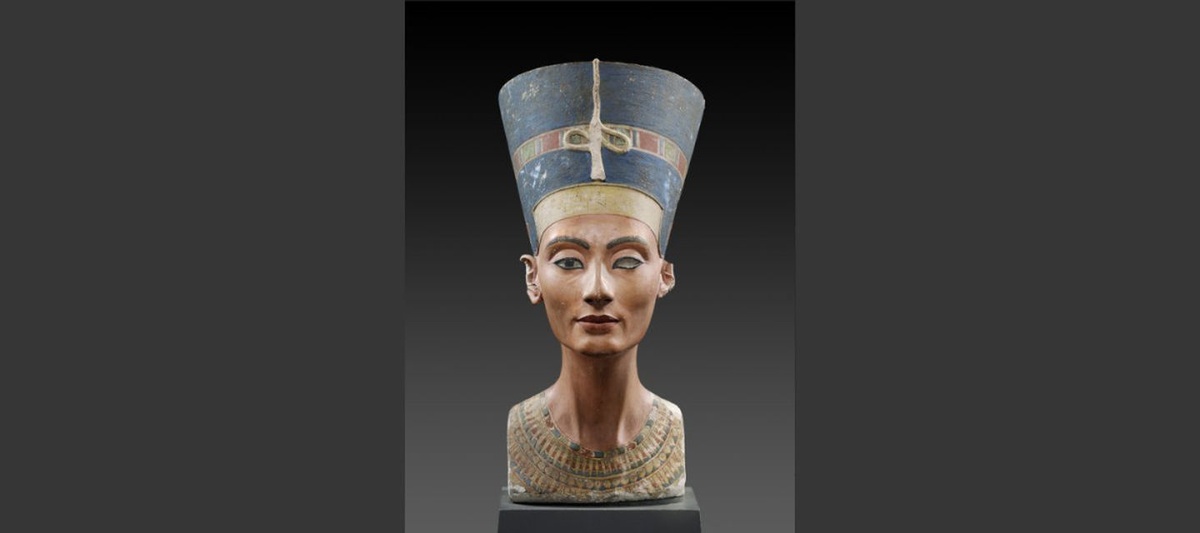
When the bust of Nefertiti, queen of Egypt’s 18th dynasty, was discovered in 1912, it marked the beginning of her global career as an iconic image. She has been admired by many; from National Socialists and nationalists in Egypt and Bengal, to prominent figures such as Beyoncé. Being on display in a Berlin museum, the bust has never been returned to Egypt. In this lecture, historian Sebastian Conrad will show how Nefertiti’s journey illuminates the changing forms of globalization, from the age of imperialism to the present.
Nefertiti was the great royal wife of pharaoh Akhenaten. The discovery of her stucco coated limestone bust in 1912 was the beginning of a career as a global icon, used for a wide variety of purposes. The silhouette alone of this powerful Ancient Egyptian queen was recognized and admired around the world, from National Socialists and nationalists in Egypt and Bengal, to prominent Black figures such as Elijah Muhammad and Beyoncé.
Immediately after its first exhibition in Berlin in 1924, Egypt unsuccessfully demanded its restitution. Still today, the bust is the must-see museum piece of the New Museum in Berlin. Against a global backdrop, historian Sebastian Conrad showcases the stunning object’s fame and the often-controversial issues and debates in which it has been embroiled. He argues that the story of Nefertiti’s trajectory offers insights into the changing shape of globalization from the era of imperialism until now.
Speakers
Sebastian Conrad is a leading scholar in global history. He holds the Chair of Modern History at Freie Universität Berlin and taught, among others, at the European University Institute in Florence. Conrad has been on the editorial board of prominent peer reviewed journals such as Geschichte und Gesellschaft and Contributions to the History of Concepts. Among his many books, he published What Is Global History? (2016), German Colonialism, A Short History (2012), and Globalisation and the Nation in Imperial Germany (2010). The English version of his German-language book on Nefertiti will be published this year.
Hanco Jürgens is a member of the academic staff of the Duitsland Instituut and a fellow at the Montesquieu Institute. He teaches German and European history at the University of Amsterdam. Jürgens’ research focuses on the history of modern Germany in both European and global contexts. Currently, he is researching the transformation of German society since the 1970s as a result of globalization, digitalization, and social changes. He has published on a wide range of topics, such as the colonial and religious history of the eighteenth century, Dutch German relations in the twentieth century, memory culture, and German EU policy.
Marieke Bloembergen is senior researcher at the Royal Netherlands Institute of Southeast Asian and Caribbean Studies (KITLV), and professor in Heritage and Postcolonial Studies in Indonesian History at Leiden University. Her research interests concern the politics of cultural knowledge and heritage formation in colonial and postcolonial Indonesia in transnational and global contexts, through the prism of sites, objects and non-human species, in relation to religion, violence, and practices of (environmental) care. Her most recent monograph, co-authored with Martijn Eickhoff, is The Politics of Heritage in Indonesia: A Cultural History (Cambridge: Cambridge University Press, 2020).
Natalie Scholz is Senior Lecturer of modern and contemporary history at the University of Amsterdam. In her work she tries to understand the culturally and emotionally mediated intersection between modern political regimes and national, ethnic and gender identities. She has published on the popular imaginations of the 19th century French Restoration monarchy and more recently on the political meanings of commodities and modernism in postwar Germany. Her latest publication is Redeeming Objects: A West German Mythology (University of Wisconsin Press 2023).