On the Shoulders of Our Ancestors
E identidad cultural Rubiano no ta un cu ta facil pa defini, atribui na Aruba su historia largo di migracion di varios pueblo y cultura. Aruba a desaroya pa bira un pais, unda por lo menos 100 nationalidad ta topa, mescla y intercambia custumber y idea. Pero ta solamente 40 aña pasa Aruba por a reclama e identidad cultural aki cu autonomia. Kico ta nifica anto pa haci e declaracion ‘Ami ta Rubiano’? Y con esaki ta cambia ora, den caso di diaspora Rubiano na Hulanda, e pais unda e identidad aki a nace ta 8000 kilometer leu?
Den ‘On the Shoulders of Our Ancestors (Riba Schouder Di Nos Antepasadonan)’ nos ta trata di explora con e identidad cultural Rubiano a bin pa existi, con el a evoluciona, y con nos por sigui reclama y practica esaki, tanto riba nos dushi isla como den su diaspora*. Tambe ta invita reflexion critico riba e rol cu colonisacion a hunga –tanto den e formacion como erosion– di identidad cultural y memoria colectivo* di Aruba.
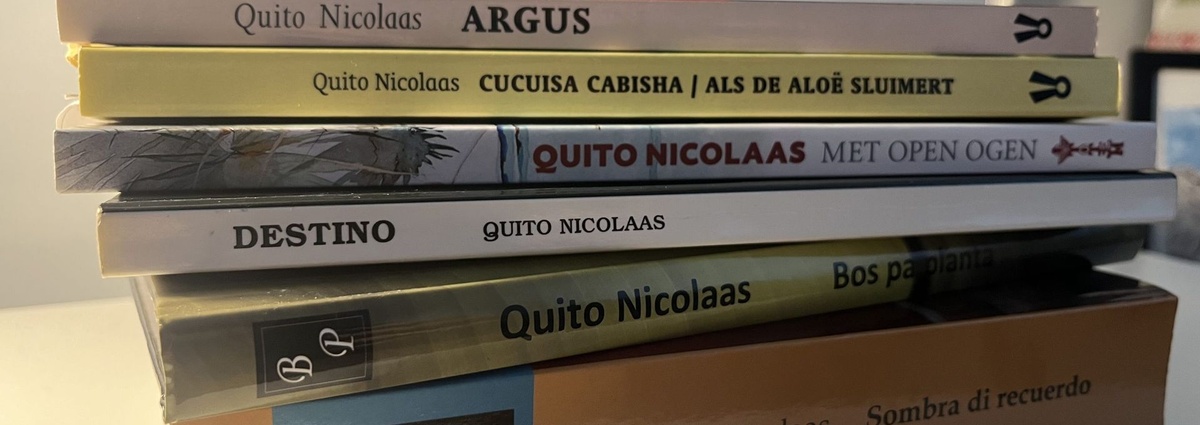
E evento aki ta cuminsa 19:30 cu un charla cortico tocante e factornan cu a forma y cu ta sigui forma nos identidad cultural. Despues nos lo tene discusion cu Quito Nicolaas, escritor y poeta cu pa siglo caba ta contribui na e documentacion y celebracion di nos cultura, hunto cu artistanan mas jong, cu lo tuma su trabou como inspiracion, y mustra nos con nos lo por conserva, honra y aprecia nos cultura den futuro.
Prome y despues cu e evento caba lo tin benta di buki facilita pa Bookish Plaza
(English Translation)
The Aruban cultural identity is not an easy one to define. Home to more than 100 nationalities, Aruba has grown into a nation where cultures meet, blend, and exchange customs and ideas. Yet it has been only forty years since Aruba could autonomously claim its own cultural identity. What does it truly mean then to make such a claim? And how does this meaning shift when, for the Aruban diaspora in the Netherlands, the land where that identity was shaped lies 8,000 kilometers away?
In ‘On the Shoulders of Our Ancestors’ we explore how Aruban cultural identity emerged, how it has evolved, and how it can continue to be practiced and reclaimed, both on the island and within its diaspora. It also invites critical reflection on the role the Netherlands has played—both in shaping and in eroding—Aruba’s cultural identity and collective memory.
This event starts at 19.30 with a lecture about the developments that have shaped and continue to shape Aruba’s cultural identity. We’ll then hold a discussion with Quito Nicolaas, an elder writer and poet who has contributed to the documentation and celebration of this cultural identity, together with younger artists who, using his work as inspiration, showcase what conserving, honouring and appreciating this culture could look like in the future.
Before and after the event Bookish Plaza will have a bookstall managed by Quito Nicolaas himself.
Together with Quito Nicolaas Writer, Poet, Essayist Pos Chikito Collective Musical Group Ludwella Singer-songwriter Failo Musician, Freestyle artist, Rapper Edrianne Tromp Multidisciplinary Artist Renwick Heronimo Art Curator & Critic Lidrick Solognier Historian, Musician, Expert Aruban TambúAbout the speakers
Quito Nicolaas is an Aruban writer, poet, and essayist. He studied cultural work in the Netherlands and subsequently pursued degrees in political science and law. He began writing during his studies and stay in Europe. Nicolaas draws inspiration from his travels, and developments in his native country as well as international politics.
Renwick Heronimo is a Curator/critic based in Aruba in the Dutch Caribbean. His career, which includes collaborations across continents, has led to a more defined focus on the activation of space and meaning through architecture, exhibit design, curatorial practice, visual arts, theater, or film. It is especially the aspect of the cultural history of the Dutch Caribbean that resonates and is of great interest, where cross-national narratives are underexposed, and where material and immaterial cultural heritage needs to be safeguarded and investigated. A task that has been a consistent focus throughout his over thirty-year career in culture.
Pos Chikito Collective is a group of creatives from Aruba made up of Yeshua, Juean and Denzil. Blending their individual styles with Tambu and Aruban musical influences, they come together to create immersive performances rooted in art, culture and creative expression. Alongside their core work, the collective actively collaborates with a wide range of artists, expanding their sound and artistic vision through cross disciplinary and cultural exchange
Faisal (Failo) Lobato. Born and raised in Aruba in a Surinamese household, he began his journey as a freestyle artist. Influenced by Caribbean rhythms and his cultural background, Failo blends these elements with modern hip hop and R&B to create his own distinct sound. Constantly surrounding himself with music and artistry, Failo continues to shape and evolve his creative identity.
Edrianne Tromp is an Aruban multidisciplinary artist based in the Netherlands. Shaped by her upbringing in Aruba, her work reflects lived experience, memory, and history. Working across painting, sculpture, and mixed media, she explores race, gender, sexuality, and identity through the lens of her Afro-Caribbean heritage. Her practice engages with ancestry, displacement, and the lasting impact of colonial histories, reclaiming inherited narratives as acts of self-expression, resistance, and healing.
Lidrick Solognier is a percussionist born and raised in Aruba with musical roots in Tambú en other traditional Aruban rhythms. Studying at Codarts in Rotterdam he developed his skills as a percussionist, exploring and playing different styles of music. His sound reflects both tradition and modern influence.
Ludwella is an Aruban singer-songwriter who combines elements of R&B, Pop-Rock and Dream Pop with the nostalgia of her Caribbean upbringing. Caught between tradition and progression, she aims with her art to facilitate conversation between past and possibility...
In Papiamento and English she shares her dreams, her fears and how in communion with nature she learns to deal with emotions that sometimes feel bigger than herself.
Definitions
*diaspora: e dispersion di un pueblo for di su tera orginal/ the dispersion or spread of a people from their original homeland.
*memoria colectivo/collective memory: e memorianan, mitonan y historia cu ta yuda un grupo social pa mantene conexion cu nan identidad./the memory, myths and histories that help a social group stay connected to their identity.