Iran: Press Freedom?
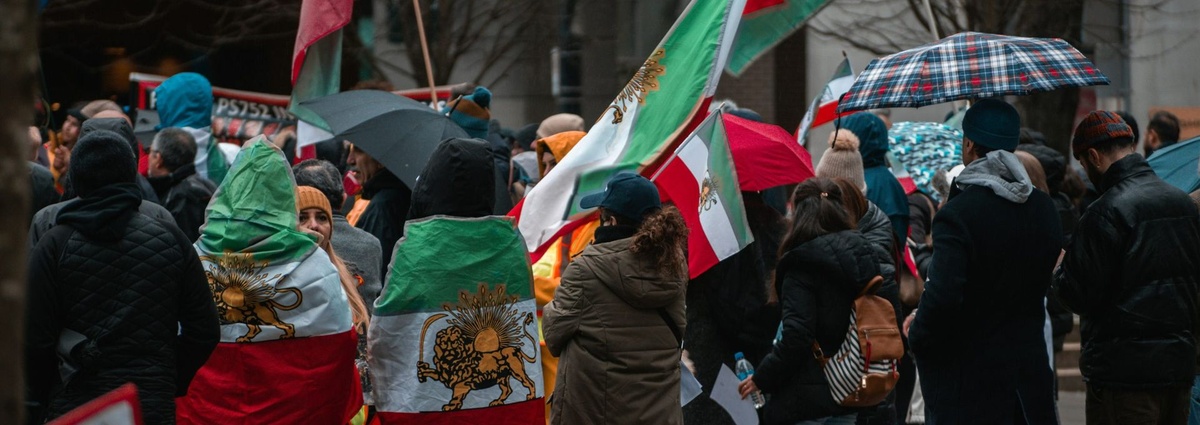
Since 28 February 2026 a major air campaign against Iran by The United States and Israel have been launched. From the beginning of this war, Iranian journalists have continued reporting while working under airstrikes and intense government pressure, while internet restrictions and digital blackouts have severely limited access to reliable information. This panel looks at how media control, propaganda and digital repression shape the flow of information in times of conflict and political crisis. It asks what these restrictions mean for journalists, citizens, human rights, and how freedom of information can still be defended under such conditions. Together with experts, we will explore the realities of reporting on Iran and discuss what is needed to protect independent media and digital rights.
In Conversation With Nafiss Nia Zakelijk- en artistiek leider Stichting Granate, dichter. Foto: Janita Sassen Ladan Rahbari Associate Professor of Sociology at the University of Amsterdam Eline Derakhshan (Freelance) Journalist specialised in the Middle East and North Africa Reza Sardari Investigative JournalistNafiss Nia is an Iranian screenwriter, director, producer, poet, writer, storyteller, and literary translator. She makes feature films, short films, and documentaries. Her feature film ‘Die middag’ premiered at the IFFR in 2023 and was subsequently screened in cinemas. In 2023, Nafiss received the Vevam Award, Forum for Directors, at the Netherlands Film Festival for directing ‘Die middag’. Nafiss has published three poetry collections: ‘Esfahan, mijn hoopstee’, ‘De ogenblik wachten ons voorbij’, and ‘26 woorden voor schoonheid’. Her poems have been included in more than forty anthologies and magazines. Nafiss Nia is also the founder and director of the Granate Foundation, a platform in Amsterdam where she combines spoken word art with film, dance, music, and other disciplines.
Dr Ladan Rahbari: She is a political sociologist and writer, and an associate professor in the Department of Sociology at the University of Amsterdam. She is also a senior researcher at the International Migration Institute (IMI). Previously, she was based at Ghent University, Belgium, where she held a postdoctoral fellowship from the Research Foundation Flanders (FWO) from 2019 to 2022. She is a member of the Amsterdam Young Academy (2021–2026). She serves as co-director and board member of the Amsterdam Research Centre for Gender and Sexuality (ARC-GS) and is a board member of the Amsterdam Centre for Migration Research (ACMR). Her research focuses on gender and migration politics, religion, the body, and digital media, particularly in relation to Iran and Western Europe, and is informed by postcolonial, feminist, and critical theory.
Eline Derakhshan is an investigative journalist from the Netherlands, specialised in West Asia and North Africa. Her work has been published and featured in De Correspondent, Vrij Nederland and VPRO Bureau Buitenland, among others. Derakhshan studied journalism in Utrecht and did her BA and MA in Middle Eastern Studies at Leiden University. She is trained in OSINT and her work focuses on human rights, migration policies, political economy and international law. In her work she tries to balance the overarching systemic reality with the real life implications for the people who are affected by it.
Reza Sardari trained as a lawyer. In Iran, he combined his work as a legal official with journalistic activities as a freelance reporter. After fleeing to the Netherlands in 2012, he continued his work as a journalist and activist. His clients are primarily international Farsi-language media outlets and civil society organizations. For example, Reza has published investigative stories on the Iranian political system and worked as a (freelance) project manager on a project focused on the rights of Iranian detainees. In addition, he collects stories from political prisoners in Iran and from political movements in the country. He is currently working on a research project about circumventing sanctions. Reza is also the founder of the Diversiteit op Niveaus foundation, which focuses on cultural diversity. Reza is affiliated with the Open Eyes Institute and RFG Media.