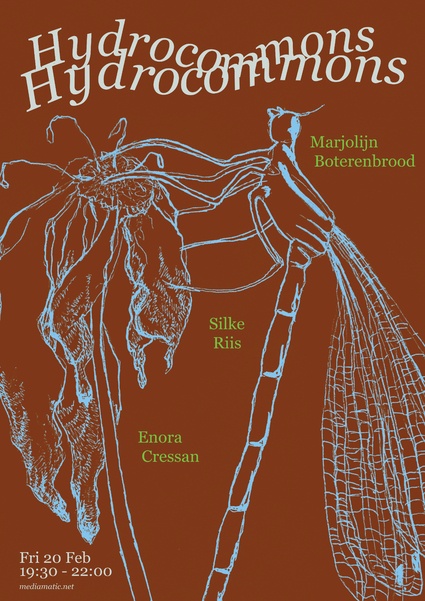
Hydrocommons
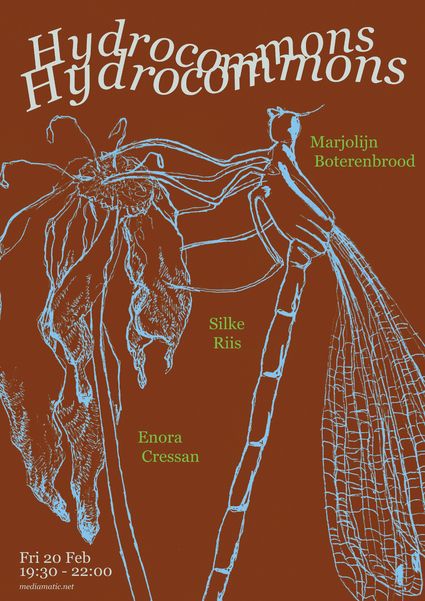
Join us on Friday, February 20th, to mark a new chapter for Mediamatic!
This evening, we explore the idea that we are not separate entities, but porous beings in the same water. When will we begin to live in the city as if we truly believed this?
Harpo 't Hart from the Embassy of the North Sea will moderate a roundtable where the perspectives of our first three artists-in-residence flow together. This conversation will be followed by an exclusive first look at our new exhibitions and Living Labs. We invite you to stay for the celebration, where we’ll toast to this new vision with drinks, music, and community by the water.
About Mediamatic's Program
We recognise ourselves in the model of a monastery: as a safe haven for knowledge development and transfer, interests in practices that require an investment of time and close attention, shared responsibilities all based on a strong DIY mentality. In the heart of Amsterdam, Mediamatic's residency program provides artists and designers with the space needed to research, develop, and prototype their projects.Hydrocommons
After more than a decade on the banks of the IJ, we have moved into a new rhythm at Mediamatic. Inspired by the shared practices of monks in monasteries, we are now living here as a community, making a collective effort to understand the more-than-human worlds that surround us.
By immersing ourselves daily in the presence of the canal, we have come to see how deeply our lives are woven into hers. We are not separate from the water; we are dependent on her shifting ways and the wisdom embedded in her constant flow. Through these complex relationships, we have realised that modern water management still treats the canal as an "other", a mere resource or a border.
We are done treating the canal as a scenic backdrop. At Mediamatic, we have entered a monastic devotion to the water, not as spectators, but as organisms submerged in a shared amniotic fluid.
To care for the canal is to acknowledge that we are already part of its metabolism.
Hydrocommons highlights the deep entanglement of all water bodies (from oceans to our own bodies) and the complex natural and cultural shaped relationships that link them. It also promotes a shift in perspective, where humans become custodians or caretakers of water rather than just owners, emphasising water's inherent non-economic value and the need for responsible stewardship.
Embassy of the North Sea
Diversity is in the interest of all life. Therefore, direct political representation of the sea and the life within it is necessary. The Embassy of the North Sea was founded on the principle that the North Sea owns itself. Their aim is to represent the plants, animals, microbes, and people in and around the North Sea in the cultural, legal, and political public domain. The Embassy has plotted a route through to 2030, firstly learning to listen to the sea before learning to speak with it. Finally, they will negotiate on behalf of the North Sea and all the life that it encapsulates.
Harpo ’t Hart (1985) is a curator, designer, and sound artist. He studied piano at the Utrecht Conservatory, Media Technology at Leiden University, and Sound Studies at the Universität der Künste Berlin. His work questions the way we listen to the world. How should we listen to our rapidly changing environment? A world shaped by climate change, a world in which electronic devices listen to us. This is why Harpo explores the possibilities of music that does not revolve around humans—a concert of things.
Jop Koopman is an anthropologist working at the Department of Organization Sciences of the Vrije Universiteit Amsterdam. Through his work, he is part of the Engaged Scholars Against Climate Change group, which studies Hydrofeminist Justice, in which he has developed a submerged methodological framework. He is interested in how alternative ways of knowing and knowledge can reorganise society from an extractive, hierarchical model to a more horizontal, nurturing one.
His research brings together anthropology, organisation studies, and critical environmental scholarship to explore how water, care, and relationality can serve as organising principles for collective life. By foregrounding submerged, often marginalised perspectives, he challenges dominant epistemologies that privilege control, efficiency, and extraction. In doing so, his work contributes to broader debates on climate justice, epistemic transformation, societal resilience, and the reimagining of institutions in the face of planetary crisis.
Meet the artists in residence

Artist in Residence Period 1 / 2026 / Mediamatic -
Enora Cressan
Material researcher and designer
Enora's work is grounded in the exploration of residual, unstable, or devalued substances (she worked with dust, fish skin, rust, or plastic) as vectors of an ecology of attention. Through their transformation, these materials become hybrid and ambiguous surfaces of interrogation; they unsettle perception and open spaces for dialogue within contexts often distant from dominant ecological discourses.
Marjolijn Boterenbrood
Multidisciplinary artist
Marjolijn Boterenbrood is a multidisciplinary artist whose works primarily revolve around the concepts of space and places through sensory impressions. Boterenbrood works through these subjects to reveal the hidden intrinsic aspects of the certain places that she visits. Through this, the places can be fully understood through the different dimensions that have been accentuated in Boterenbrood’s works.
Silke Riis
Sculptor and installation artist Using natural latex in experimental ways Silke creates slowly decaying sculptures, mimicking the fragility of life itself. Her work is part of the science-fiction subgenre and artistic movement ‘speculative evolution’, which blends evolutionary science and biology with fantasy to create new plants and animals from speculative futures. Her sculptures can be seen as these hypothetical species, and through this practice she playfully envisions a future beyond our timeline. To Silke, the future is equally scary as it is exciting, and she translates this duality into her sculptures that are both creepy and beautiful, dystopian and utopian at the same time.Tickets
Free Entrance Event - RSVP
Information
Friday February 20th / 19:30 - 22:00
Language: English
Program:
19:15 - 19:30: Doors open and welcome drink
19:30 - 20:30: Round Table
20:30 - 20:45: Studio visit with Marjolijn Boterenbrood
20:45 - 21:00: Studio visit with Enora Cressan
21:00 - 21:15: Exhibition visit with Silke Riis
21:15 - 22:15: Drinks & Music!
Mediamatic Biotoop, Dijksgracht 6, Amsterdam - Plantkamer, Clean Lab, Haeckel, Haptic Lab & Sluisdeurenloods building
For questions, please send an email to program@mediamatic.nl.
Accessibility
If you have any questions about the accessibility of this event, please get in touch with mail@mediamatic.nl
This event is made possible by:

Logo Design // AFK / Mondriaan Fonds / SCI / Gemeente Amsterdam -
Sculptor and installation artist Using natural latex in experimental ways Silke creates slowly decaying sculptures, mimicking the fragility of life itself. Her work is part of the science-fiction subgenre and artistic movement ‘speculative evolution’, which blends evolutionary science and biology with fantasy to create new plants and animals from speculative futures. Her sculptures can be seen as these hypothetical species, and through this practice she playfully envisions a future beyond our timeline. To Silke, the future is equally scary as it is exciting, and she translates this duality into her sculptures that are both creepy and beautiful, dystopian and utopian at the same time.