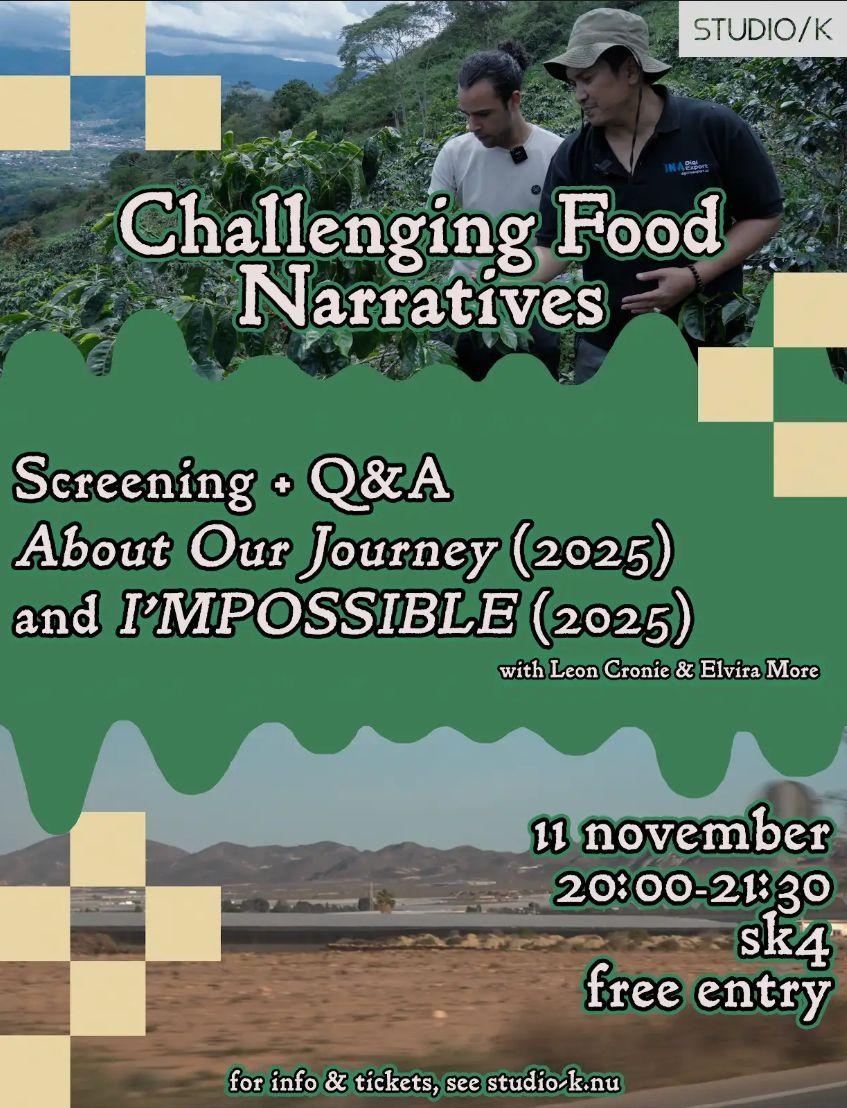
FILM SCREENING + Q&A | Challenging Food Narratives with About Our Journey and I’MPOSSIBLE.
FILM SCREENING + Q&A | Challenging Food Narratives with About Our Journey and I’MPOSSIBLE.
one hand, labour migrants, mostly from the Global South, are expected to harvest our veggies in
the most terrible working conditions violating all kinds of laws, while European political and social
discourses are becoming increasingly xenophobic, portraying them as inhumane or even
criminals. On the other, farmers in the Global South are suffocating due to Western companies
demanding extremely high quality products, aligned with consumers’ demand for ethical, organic
products. Marketing executives work hard to make us believe that by making the right choices, by
being a ‘conscious consumer’, we can change the lives of disadvantaged communities abroad —
while high profits are still being made by exploiting local farmers and their resources. Voices from within marginalised communities who actually produce our foods are rarely present in these stories. In Visual Anthropology, there has been a movement to change that: ethnographers are making efforts to work together with local communities, instead of producing research about them. Elvira Mora and Leon Cronie decided to follow this participatory method in their filmmaking efforts. For their graduation projects, they carried out fieldwork in Spain and Indonesia as part of different projects, with the same mission. Whether about coffee or about migration, they both challenge narratives about representation of the Other, to combat hidden power dynamics within ethnographic filming. Join us for a screening of their films at Studio /K’s intimate space SK4. After watching the documentaries together, we’ll dive deeper into the topic with Elvira and Leon. November 11th
20:00 – 21:30
Studio/K, SK4 Free entry About Our Journey (2025) is a film set in both The Netherlands and Indonesia, about narratives that dominate the specialty coffee industry. In these hopeful “coffee origin stories”, coffee farmers in the Global South are perfect victims, while the Western coffee importer is presented as the hero. By paying a little extra for a cup of high-quality coffee, consumers are led to believe they can change lives of local farmers. How can we believe such stories when many coffee-producing communities are still living in poverty, despite the ubiquity of heartwarming coffee stories in urban, cosmopolitan spaces? For his graduation project, part of the Masters’ Visual Ethnography, Leon Cronie set out to find ‘the truth’ behind coffee origin stories by travelling to Sumatra, Indonesia. Talking to industry representatives and farmers however, he finds that his mission may be more complicated than expected. Does he himself have the right to tell this story? I’MPOSSIBLE (2025) follows Abdellah, Rachid, Mohamed, Toufik, and Saikou, five men who migrated to Europe in search of better opportunities and now work in the greenhouse industry of Almería, southeast Spain. Through their testimonies, daily routines, and the use of participatory filmmaking, the film explores the link between migrant labour exploitation and the precarious living conditions in informal settlements. Due to their documentation status, exploitative labour, and the absence of housing solutions, many migrants in Almería endure daily struggles: unreliable water and electricity, extreme summer heat, poor waste management, and social marginalisation. By placing the camera in the hands of some participants and filming others in close collaboration, I’MPOSSIBLE moves beyond victimisation and shows migration as a state rather than an essence.The film invites viewers to reflect on representational authority and the power relations embedded in migration images, which increased after the so-called “migration/refugee crisis” of 2015. It challenges essentialising portrayals of migrants as an exotic ‘other’ by offering an alternative mode of representation in which the protagonists tell their own story with dignity and agency. Leon Cronie is an anthropologist and documentary filmmaker. His work brings together a wide range of themes, from stories about coffee to the Palestinian cause, always taking a decolonial perspective as his starting point. Armed with a camera, he focuses on the struggle for justice, not as a neutral fly-on-the-wall observer but as an active participant. He is currently working on a documentary about the deep mistrust felt by young people of colour towards the police. On Instagram and YouTube, he uploads short videos about injustice, from the right to protest to racism in football. Elvira Mora is a graduate of the Visual Ethnography specialisation in Cultural Anthropology and Development Sociology at Leiden University. Her first project as a visual ethnographer focuses on migration, labour exploitation, and participatory filmmaking in Campos de Níjar, Almería (Spain). Her personal connection to the territory where she grew up motivated her, alongside her mother Teresa as her collaborator, to seek a deeper understanding of the reality migrants face in the agroindustrial sector. Working on this project has strengthened her awareness of why participatory methods are essential to preserve migrant voices in multimodal projects. For her future career, she is determined to develop visual participatory projects focused on migration and gender studies.
in 19 days
Studio K
Timorplein 62, 1094 CC Amsterdam