Climate Justice and Right to Housing
How do climate change, social inequality and the right to housing intersect? Who carries the weight of increasingly extreme weather, and who has the means to adapt? This evening, we dive into questions of environmental justice, urban inequality, and design for a climate-resilient future. We’ll explore these global–local connections through the lens of Designing Tomorrow Together, a platform by Studio Akeka, in collaboration with Endeavour and Local Works. The initiative stimulates dialogue on climate-resilient design from a perspective of social equity, focusing on our shared future.
Together with Shinnosuke Albert Wasswa Architect & Urban Designer at Studio Akeka Erik Swyngedouw Professor of Geography, University of Manchester Remco Rolvink Urban Planner & Co-owner at VE-R, Co-founder of DASUDA Raina Ghosh Visiting Fellow at the University of Amsterdam under the Urban Studies Foundation International FellowshipErik Swyngedouw is Professor of Geography at The University of Manchester, UK and Senior Research Associate of the University of Johannesburg Centre for Social Change, South Africa. He holds a doctorate from The Johns Hopkins University and was awarded Honorary Doctorates from Roskilde University and the University of Malmö. He works on political ecology, critical theory, environmental and emancipatory politics. He is author of, among others, Promises of the Political: Insurgent Cities in a Post-Democratic Environment (MIT Press), Liquid Power: Contested Hydro-Modernities in 20th Century Spain (MIT Press) and Social Power and the Urbanization of Nature (Oxford University Press). He is currently completing a book (with Prof. Lucas Pohl), entitled Enjoying Climate Change (Verso).
Raina Ghosh is a Visiting Fellow at the University of Amsterdam under the Urban Studies Foundation International Fellowship. She is a human geographer specializing in urban political ecology, water–society relations, and urban spatial politics. She holds a PhD in Geography from Jawaharlal Nehru University, New Delhi, India, where her research examined everyday city-making processes at Kolkata’s riverine ghats along the Hooghly River. Her current project explores how sacred riverfronts in India are reshaped by Hindu nationalist urbanism, informal authority, and everyday practices, focusing on how rivers, deities, and ritual infrastructures influence the politics and production of urban space.
Remco Rolvink has over 25 years of experience as urban planner, landscape architect and spatial strategist. Remco cofounded the design agency VE-R landscape architecture and urbanism together with Berrie van Elderen in 2019. He also co-founded the DASUDA foundation, Dutch Alliance for Sustainable Urban Development in Africa in 2013. Recently, Remco was lead designer for the Liberia Urban Resilience Project in Monrovia in Liberia (2025-present), was project lead of the redevelopment of the main infrastructure and public transport hub of Old Taxi Park in the centre of Kampala in Uganda (2020-2025) for the new terminal design and the TOD strategy for the city centre, and he was lead urban planner in the participatory design charrette for open space, river management and city redevelopment in the Msimbazi River Basin of Dar es Salaam in Tanzania which resulted in the Msimbazi Opportunity Plan (MOP, 2019) and continued in the Lower Msimbazi Upgrading Project (LMUP, 2023). This last project was besides a river landscape design also an urban scheme for densified neighbourhoods at the river front for 15.000 new housing units. Furthermore, Remco was lead planner for the SERRP storm surge resettlement Saint Louis, Senegal (2020) on the participatory urban planning process.
Shinnosuke Albert Wasswa is an urbanist and architect at Studio Akeka, a multi-disciplinary design collaborative that operates across Europe and Africa. Prior to moving to the Netherlands, his work focused on design+build architectural projects that leverage locally available materials, artisanry and climatic conditions, notably Muyenga Tankhill Park (2018) in Kampala. Since specialising in urbanism at TU Delft, his passion lies in planetary ecology, climate adaptation and spatial justice with a focus on addressing socio-ecological challenges in sub-Saharan Africa. In his master’s thesis (2023), he explored the use of storytelling as a method to co-envision a just future and inform policies that recognise the marginalised Batwa community in the former Gahinga forest in south-western Uganda. Currently working on the Designing Tomorrow Together project (2025) that addresses the disconnect between formal and informal actors in the flood prone Bwaise neighbourhood in Kampala.
More information about this programme
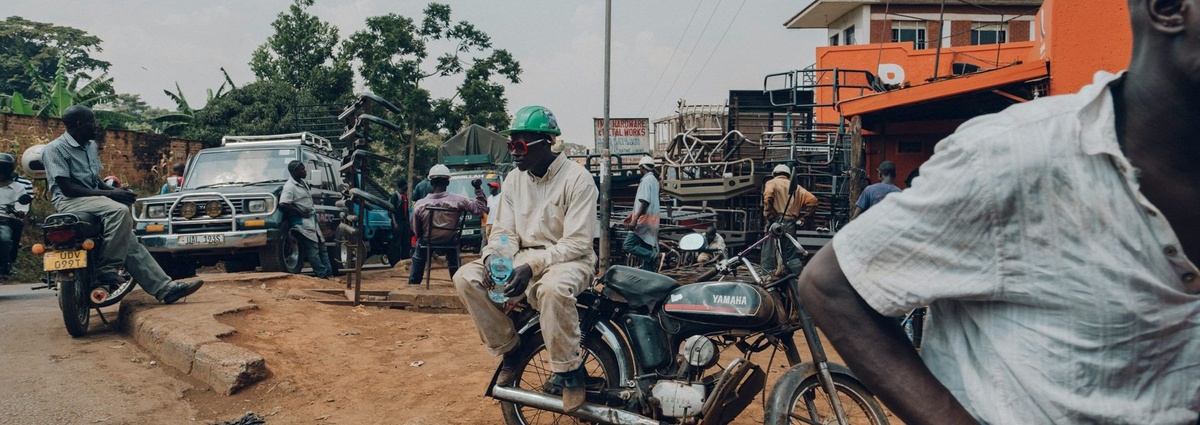
Intensifying forest fires, floods, landslides and droughts are frequent events. The Netherlands, a long-standing symbol of mastery over water, proves that engineering, technology and wealth can still buy time. Elsewhere, even small shifts in sea level or rainfall already threaten millions. In East Africa, the rainy seasons are growing longer and more destructive. Kampala, Uganda’s fast-growing capital, stands as a striking example. The combination of a growing city without sufficient planning and weak infrastructure has turned rainfall into crisis. Fast urbanisation, with increasing soil-sealing and a fragile stormwater system, collapses under the strain. Meanwhile, imported fossil-fuel vehicles from the decarbonizing North add to pollution and congestion. This drives low-income families, seeking economic opportunities in the urban core, to the flood-prone wetlands connected to Lake Victoria, where many depend on informal work and are most vulnerable to climate disaster.
Kampala’s geography deepens this divide. The wealthier live safely on the hills; the poor are left to face the water that rushes down into the valleys. Each storm poses a risk to livelihoods and spread of disease. What used to be an exceptional weather event has become a frequent reality. Flooding in Uganda is not only an environmental problem; it’s a social one. It reveals how inequality, environmental justice, planning, and climate are interwoven. The struggle over water is also a struggle over justice.
In this session, designers and researchers from Uganda and the Netherlands come together to discuss how climate change reshapes everyday urban life in the Global South and how those realities connect directly to decisions made in the Global North. With a special focus on Bwaise, a densely populated neighborhood in Kampala, we will look at how local communities face, adapt to, and resist the mounting challenges of floods, displacement, and environmental injustice.
Join us for a conversation on how to design for tomorrow together!