CiNEMERCATOR - Beautiful Day 2012
Filmlover,
Merthe Voorhoeve,
Andreas van Riet,
Maaike Hasselaar
& Elisabeth van Vliet,
each are programming 1 precious film per month. That's 4 precious films per month!
CiNEMERCATOR
doors open 19:00
start 20:00
ticket 3€
2-9
Don Hertzfeldt
It's such a Beautiful Day
2012
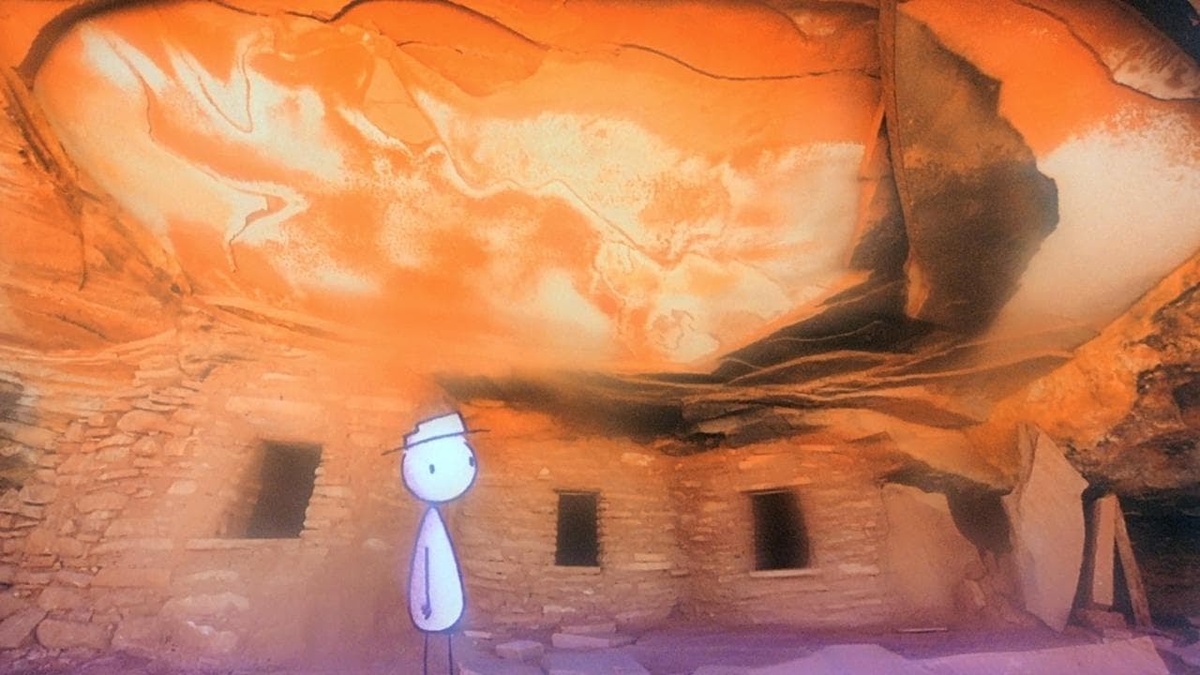
Don Hertzfeldt’s It’s Such a Beautiful Day looks almost aggressively simple: stick figures, sparse black-and-white drawings, a narrator describing the small events in one man’s life. But gradually, almost without announcing what it is doing, the film opens into something enormous.
Bill is an ordinary man whose mind is beginning to fail him. Hertzfeldt never turns this into a conventional story about illness. Instead, we experience the world increasingly through Bill’s unstable perception: memories become unreliable, time jumps, insignificant observations suddenly feel profound, and moments of terror sit directly beside absurd jokes. The film is very funny, often in places where it probably shouldn’t be, and that humour keeps it from becoming sentimental.
Hertzfeldt made the film almost entirely by himself: writing, directing, animating, photographing, editing and narrating it. He first became known for extremely minimal, darkly comic animated shorts, most famously the Oscar-nominated Rejected (2000).
The title could easily have been ironic. By the end, it isn’t. It’s Such a Beautiful Day is interested in beauty precisely because life is temporary, confusing and frequently ridiculous...
This film is chosen by Andreas
9-9
Michael Radford
1984
1984
Michael Radford’s 1984 is a remarkably faithful adaptation of George Orwell’s final novel, published in 1949.
Orwell wrote Nineteen Eighty-Four in the aftermath of fascism, Stalinism and the Second World War, while seriously ill with tuberculosis. He was interested not simply in dictatorship, but in the mechanisms through which power becomes permanent. His great insight was that controlling people’s actions is not enough; absolute power requires control over memory, language and eventually reality itself.
Radford stays very close to this idea. Winston Smith works at the Ministry of Truth, altering old newspapers so that the past always agrees with whatever the Party currently says. His rebellion begins with something tiny: he starts a diary. From there, remembering, writing, having sex and falling in love all become political acts, because they create experiences that belong to the individual rather than the state.
Radford made the unusual decision to shoot the film during the exact period in which Orwell set the novel: April to June 1984. This gives the adaptation an interesting relationship with its source. Orwell had imagined a future, but by the time Radford filmed it, that future had arrived. Instead of asking whether Orwell had accurately predicted 1984, the film asks a more interesting questions: how much of what he warned about had already become recognizable? What happens when power gains control over the shared facts people need- in order to disagree with it? How do you defend reality when you can no longer prove that it exists?
This film is chosen by Maaike
16-9
Stanley Kubrik
1984
1999
'Perhaps intimacy begins when we stop pretending we can ever completely possess or understand the person beside us.'
Stanley Kubrick’s Eyes Wide Shut begins with a marriage and slowly turns it into a mystery. Tom Cruise and Nicole Kidman play Bill and Alice Harford, a wealthy New York couple whose comfortable relationship is disturbed when Alice admits that she once fantasised about leaving Bill for another man. Nothing actually happened, but for Bill the thought is enough. He walks out into the city and spends the night drifting through a succession of sexual encounters, imagined possibilities and increasingly strange rooms.
It was Kubrick’s final film, based on Arthur Schnitzler’s 1926 novella Traumnovelle (Dream Story). Kubrick and screenwriter Frederic Raphael moved the story to contemporary New York while keeping its dream structure. New York itself was largely recreated on sets in England. The result is recognisable but never completely convincing- which is precisely right for the film. Bill travels through the city as if moving through his own unconscious. Doors open too easily, strangers appear at exactly the right moment, conversations feel slightly unreal.
Kubrick was famous for long productions and obsessive control, and Eyes Wide Shut became an extreme example: principal photography lasted well over a year, contributing to its reputation as one of the longest continuous film shoots. Kubrick died in March 1999, only days after showing a cut of the film to Cruise and Kidman. It was released that summer.
This film is chosen by Merthe
Do you want to receive our