Annotations to the Image
The programme Annotations to the Image features interventions by artists Chaw Ei Thein, Isshaq Albarbary, Sawangwongse Yawnghwe, Haig Aivazian, Hannah Black and Nolan Oswald Dennis, tracing the material conditions and political commitments informing the works on view in the exhibition Life After Love: In Search of the Militant Image.
Please register here
Programme15:00 Artists’ Street: A Walking Tour with Chaw Ei Thein
16:00 The making of Kharajat (She Went Out) with Isshaq Albarbary
17:00 The making of People’s Defence Force I–X with Sawangwongse Yawnghwe
18:00 Readings by Haig Aivazian, Hannah Black and Nolan Oswald Dennis
Artists’ Street: A Walking Tour with Chaw Ei Thein
Join Chaw Ei Thein for a walking tour through Artists’ Street, her installation of thirty-eight hand-sewn textile figures that reconstruct scenes of artistic protest against military rule in Myanmar, from the student demonstrations of 1996 through the 2007 Saffron Revolution to the aftermath of the 2021 coup. Moving from figure to figure, the artist tells the stories behind each scene, some she witnessed, others passed to her through orality and scattered documentation. The dolls form an archive of street performance that exists almost nowhere else, a record of coded gestures, staged interruptions and small public absurdities improvised against censorship and violence. Light enough to travel in a bag, they follow the path of the exiled.
The making of Kharajat (She Went Out) with Isshaq Albarbary
Isshaq Albarbary retraces the making of Kharajat (She Went Out), his film co-commissioned for Life After Love. The work takes as its starting point two recordings of Israeli mustaʿribīn, undercover units who disguise themselves as Palestinians. In 2015, security cameras at a hospital in al-Khalil captured a unit entering the premises, one member disguised as a woman in labour, another pushed in a wheelchair. In 2017, handheld cameras at Bethlehem’s northern entrance recorded plain-clothes men pulling on balaclavas and seizing Palestinian protesters. Woven through the film is a new muwashshaḥ, written by Albarbary and his twin brother after an anonymous Andalusian original, and composed and sung by Maya Khalidi. Albarbary draws on tanaaqush, an Arabic term that brings together the acts of engraving and argument, to explore how images leave their marks on one another. This exchange also informs his wider engagement with the histories and inheritances of stateless refugees.
The making of People’s Defence Force I–X with Sawangwongse Yawnghwe
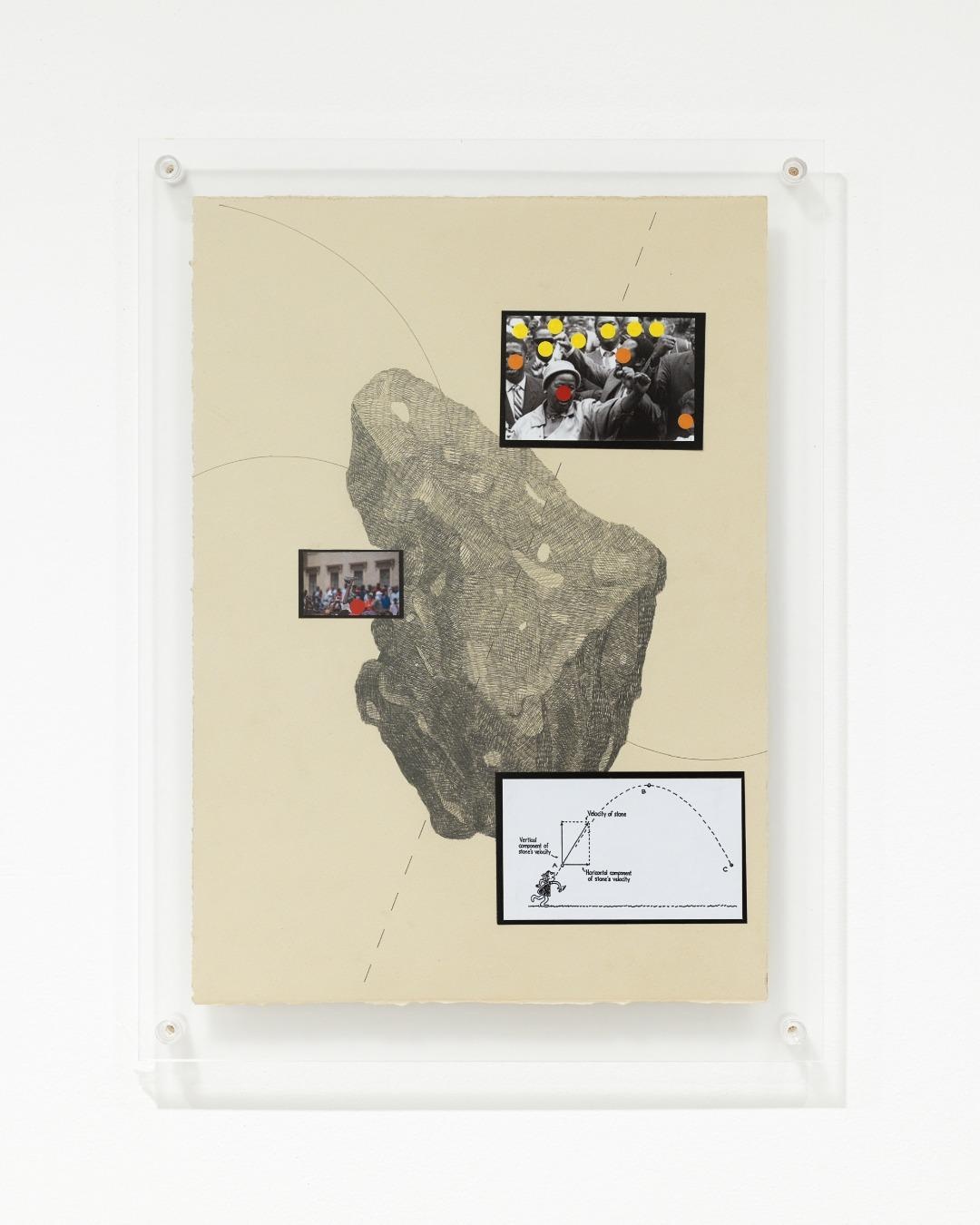
Sawangwongse Yawnghwe presents People’s Defence Force I–X, a series of paintings made in the wake of Burma’s 2021 Spring Revolution. Drawing on the stories and images of protesters, the series considers what Frantz Fanon and Zahi Zalloua might describe as a form of symbolic suicide, when individuals relinquish their established identities and enter a radically different political existence. For many, this transformation meant fleeing to the jungle and taking up arms, either by joining the newly formed People’s Defence Forces (PDFs) or by allying themselves with established ethnic armed organisations. Yawnghwe situates these paintings within a longer history of uprisings against military rule, in which his own family participated, and returns to a question that runs through his work: Which way to land?
Readings by Haig Aivazian, Hannah Black and Nolan Oswald Dennis
Haig Aivazian, Hannah Black, and Nolan Oswald Dennis bring together a selection of texts and reflections that extend their contributions to Life After Love. They move between artistic research and polemical expression to consider the image’s relationship to political education.
Curated by Hera Chan and Edwin Nasr, the exhibition Life After Love: In Search of the Militant Image asks what the changing forms of political struggle reveal about the changing forms of image-making. If the militant image of the twentieth century emerged alongside mass party politics, anti-colonial liberation movements and the project of revolutionary cinema, what becomes of that tradition within a conjuncture shaped by digital platforms, algorithmic circulation and decentralised forms of political organising?
The exhibition approaches the militant image as a historical category, which has always depended upon particular forms of mediation. Earlier traditions of militant image-making were sustained by formations capable of producing and circulating images in the name of a collective political subject. Their ambitions were inseparable from the infrastructures through which they moved and the revolutionary horizons they sought to cultivate.
Contemporary uprisings unfold under markedly different terms. Images now circulate across encrypted messaging applications, social media feeds and informal digital networks whose logics reshape our visibility and attention. Often produced by those embedded within the events themselves, they move rapidly between testimony, tactical communication and affective expression. Their aesthetic form bears the imprint of the political moment from which they emerge: anonymity, spontaneity and opacity become qualities inscribed within the images.
Rather than asking whether the militant image survives in the present, Life After Love asks how its political function has been transformed, and what this transformation discloses about the actuality of struggle. The works assembled here reflect upon the conditions through which images are produced, circulated, appropriated and contested. Many emerge from practices situated alongside political organising, mutual aid and community work, where cultural production unfolds in close proximity to lived struggle and the imperative of internationalist solidarity. Taken together, they invite viewers to consider the militant image in the present tense and the forms through which emancipatory futures become thinkable.
Info & CreditsThis event is in English.
Admission is free, pay what you can. Do you also think art should be free and accessible? Please consider supporting us with a donation when registering or by becoming a Framer Framed Friend!
For seated programmes, places are always made available for wheelchair users. Please speak to the host before the programme begins.
This event may be photographed and filmed. Kindly let us know in advance if you prefer not to have your picture taken.
Framer Framed is supported by the Ministry of Education, Culture and Science; Amsterdam Fund for the Arts; and Municipality of Amsterdam.
LocationFramer Framed
Oranje-Vrijstaatkade 71
1093KS, Amsterdam