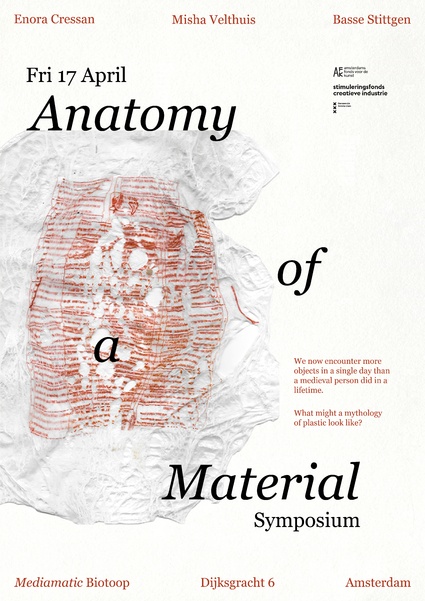
Anatomy of a Material
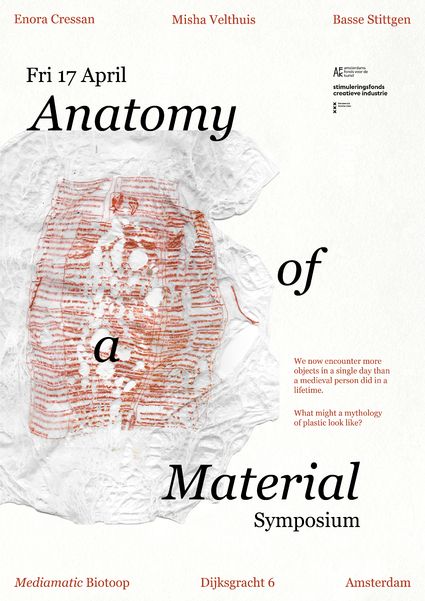
Join us on Friday, April 17th, for a symposium on affective obsolescence: the gradual erosion of our emotional and sensory connection to the materials that shape everyday life.
We now encounter more objects in a single day than a medieval person did in a lifetime. In this state of relentless novelty, surfaces multiply, and attachment fades. Enora Cressan's research at Mediamatic sits at the heart of this condition: how do we lose our feeling for the things around us, and what do we lose with it?
Tickets
Enora Cressan
Material researcher and designer
Enora's work is grounded in the exploration of residual, unstable, or devalued substances (she's worked with dust, fish skin, rust, and plastic) as vectors of an ecology of attention. Through their transformation, these materials become hybrid and ambiguous surfaces of interrogation; they unsettle perception and open spaces for dialogue within contexts often distant from dominant ecological discourses.
Misha Velthuis
Earth Scientist and Political Ecologist
Misha generally tries to explore how we depend on each other and the world around us, and how these dependencies are changing (being changed) over time. This broad interest has led him to collect stories on the expansion of supermarket chains in agricultural markets in India, but has also opened up research questions on climate science, climate denialism and the rise of the far right. The last two years, Misha has been increasingly concerned over the way we are digitally connected: who and what do we depend on? What alternative digital worlds are possible?
Basse Stittgen
Designer - Material Research
Basse's work is positioned at the intersection of design, art and material research. It stems from a fascination for matter, how it can be created, cared for, and questioned to unfold hidden narratives. His work also looks for ways in which objects can mediate contemporary complexities by way of making invisible processes tangible. It puts things out of place and reshapes them through tools and processes that are developed from looking at the world through a lens of materiality.
Lina Bravo Mora
Artistic researcher
Artist and facilitator working with clay, water, soil, food and fire, researching visions and sensations on the geologies of touch, and our not-so-innocent entanglements with the territories we inhabit, dream of, and/or are part of. With a background in social anthropology, critical pedagogies, and creative conflict transformation, now learning about generative somatics and embodiment for social justice. Lina creates and holds collective spaces for sensuous grief, nourishment, fractal heartenings, and pleasure with a decolonial, feminist, intersectional approach. She works with material storytelling creating installations, lecture performances, videos, and workshops/laboratories for diverse communities.
Anatomy of a Material
When we think about ecological innovation and environmental responsibility, synthetic materials are often spontaneously excluded from the collective imagination. Following the repeated and undeniable evidence of the damage caused by plastic waste, this material has come to embody a contemporary disaster. It is no longer perceived merely as a technical problem; but considered as a morally reprehensible substance.
By contrast, so-called traditional materials such as wood, leather, or wool continue to be seen in a positive light, evoking craftsmanship, heritage, and historical depth. As Ettore Sottsass once remarked about ceramics, “a material carries within it the memory of the civilisations that preceded us.” Plastic, by contrast, with its unremarkable, smooth surface, devoid of organic character, seems condemned to carry no memory or symbolic depth.
If the ecological transition is also cultural, then it ultimately depends on our ability to transform the way we see.
This opposition stems less from the intrinsic properties of materials than from the narratives we build around them. Plastic is not inherently problematic; instead, it has been culturally defined by its own disposability. It is neither repaired nor maintained, and certainly never cherished. It became culturally obsolete long before it is materially exhausted. Its physical durability paradoxically becomes its greatest liability, while its rejection is driven by a form of affective obsolescence: we simply stop desiring, considering, or preserving it.

"Anatomy of a Material", Enora Cressan research -
What might a mythology of plastic look like?
Countering the logic of disposability requires more than just technical optimisation or improved recycling rates, it demands a fundamental shift in how we relate to plastic. Perhaps we should approach the material with a culture of care, maintenance, and attachment. In other words, it's through emotional investment that an object begins to gain respect.
Within this reconfiguration, design occupies a central role. By making the processes of transformation visible, embracing the aesthetic traces of recycling, and creating objects meant for disassembly, design can counter plastic’s affective obsolescence and grant it a new, enduring temporality.
In other words, its through emotional investment that an object begins to gain respect.
This raises an open question: what might a mythology of plastic look like? What narratives, gestures, and images could grant it symbolic depth? Could its capacity for metamorphosis be celebrated, its cycles of transformation narrated, its rebirth staged rather than its accumulation? Which companies might dare to grant it an aura, not by concealing its synthetic nature but by embracing it as a defining material of our modernity?
If the ecological transition is also cultural, then it ultimately depends on our ability to transform the way we see. Inventing a mythology of plastic would not mean denying its impacts, but rather moving beyond its current status in order to build a more conscious, more careful, and perhaps once again desirable relationship with it.
Tickets
Full Price: €12.50
Artist/Student Price: €8.50
Information
Friday April 17th
11:00 - 16:00
Language: English
Program:
11:00 - 11:45: Presentation - Misha Velthuis
12:00 - 12:45: Presentation - Lina Bravo Mora
13:00 - 14:00: Lunch break (you are welcome to grab lunch at De Sering Centraal for €7.50)
14:00 - 14:45: Presentation - Enora Cressan
15:00 - 15:45: Presentation - Basse Stittgen
15:45 - 16:00: Questions / Wrap-up
Mediamatic Biotoop, Dijksgracht 6, Amsterdam - Clean Lab & Haeckel Room
For questions, please send an email to program@mediamatic.nl.
Accessibility
If you have any questions about the accessibility of this event, please get in touch with mail@mediamatic.nl
This event is made possible by: