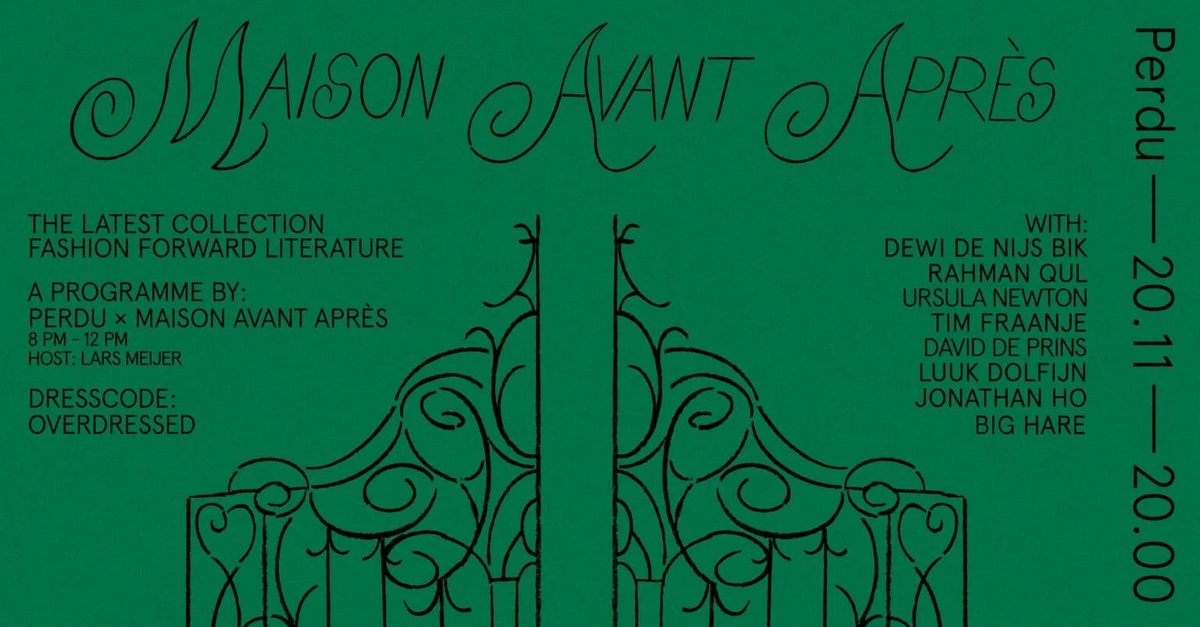
Perdu Avond: Maison Avant / Après
Maison Avant Après is a new project that opens up a space for literature on fashion. Maison Avant Après presents its debut collection Haute Écriture during this festive Evening full of poetry and performance, audiovisual spectacle and danceable music.
On 20 November Maison Avant Après presents their first collection Haute Écriture. The écrituriers of service turn their fascination for fashion into strange and dazzling pieces full of paradoxes. The practitioner of haute écriture spends years gathering enough impressions and spends hundreds of hours on the tiniest details. The pieces on show are made using complex techniques and paradoxical feelings. We see how fashion dictates strict laws and conceals oppression, but also offers possibilities to escape corsets and straightjackets.
During the presentation, the Maison proudly shows the result of this labour, hoping to form an artistic avant-garde together with the audience rather than a flock of passive fashion victims. There is no doubt that fashion has the power to mobilise the masses, but can the continuous metamorphosis on the catwalk bring about real, substantial change?
Hurry to the front row!
A programme by Perdu x Maison Avant Après
Host: Lars Meijer
Language: EN/NL (during the Dutch parts, English translations are shown)
Dress code: Overdressed
Dewi de Nijs Bik relates to the Radical Call for Love collection of fashion designer Marine Serre, who took the fashion world by storm a decade ago in the aftermath of the attacks in Paris and Brussels. What remains of this mobilizing energy in 2026? And how do these remnants inscribe themselves into history? This new poetry work, shaped through a process of upcycling, will be presented by the enigmatic model Ursula Newton and resonates within a larger stitchwork, alongside the poetry of Rahman Qul.
Rahman Qul presents his “G-Star RAW 69” as well as new poetry work, turning metropolitan Paris – global fashion capital – into an echo chamber for post-Soviet experiences and the stories of marginalized communities that have ended up in Limburg. Through the perspective of someone whose heart moves between cultures, he shows how people with limited means use fashion to shape their desire for a luxurious, post-capitalist world. DAVID de prins created accompanying video works.
Tim Fraanje provides a fashion commentary to Alessandro Michele’s debut-couture show Valentino Vertigineux (2025), of which a rich selection of video fragments is shown. What can this exorbitant parade teach us about abundance and excess? Luuk Dolfijn joins on the drums. Tim and Luuk bring musical closure to the evening by going on stage for a second time as music duo Big Hare. They give a demonstration of Solarcore, a danceable method to manifest a magnificent, solar powered future. The performance includes a display of futuristic solarcore costumes made by designer Jonathan Ho.
Rainer Diana Hamilton and Violet Spurlock are the writers of the text What does it mean to be well-dressed? in which they explore the idea of fashion as a collective dialogue. In their absence, the audience will perform this polyphonic conversation introduced by host Lars Meijer.
Dewi de Nijs Bik made her debut in 2023 with the poetry collection Indolente (De Arbeiderspers), which was nominated for the Grote Poëzieprijs, the Herman de Coninckprijs, and the C. Buddingh’-prijs and was awarded the Henriette Roland Holstprijs 2026. Indolente is currently featured at the Literature Museum as part of the exhibition “Because we have lived and still exist” which explores literary perspectives on the Indonesian independence.
Ursula Newton was born in 2020 as the alternative identity of a poet, to use in the fashion world. Ursula debuted at Paris Fasion Week SS27 for Pauline Blind.
Rahman Qul – the pseudonym of Roman Ansari (1995) is a poet, thinker, and visionary. His name, uprooted from the (anti)poetical post-taliban tradition from the heart of Asia. His poetics are nourished by punk, sampling en остранение, as well as by the fashion and visual language of houses like Maison Margiela. He works with fragmentation, deconstruction, and anti-aesthetics: poetry that is deliberately unfinished, asymmetrical, and disruptive. His work has previously appeared in Kluger Hans, De Revisor and Hard//hoofd. In 2025, he participated in the deBuren writing residency in Paris. He is currently working on his poetry debut.
DAVID de prins is an artist who departs from contradiction and imagination, seeking serenity amidst constant estrangement. As a mythical figure he moves between worlds and contradictions, looking for a way to exist within them. Currently he works on Don’t Touch My Hair, an artistic research project supported by Fonds ZOZ.
Authors Rainer Diana Hamilton and Violet Spurlock together wrote This Reasonable Habit, a book-length poem. Over the course of a long phone call, the two become hosts of an imaginary literary summit where attendees spar over casualwear, animal metaphors, fascist art, bodily autonomy, and other problems of the everyday. The authors will not be present, but the chapter What does it mean to be well dressed will be performed through a collective reading.
Tim Fraanje makes music, teaches at a fashion institute in Amsterdam and writes. He worked for VICE as a societyjournalist and for i-D as a fashion columnist. He also had a trashy glamour column on Hard//hoofd and wrote for De Architect. As part of the Solarcore project he writes futuristic E-sermons for a small but devoted cult of followers.
Luuk Dolfijn is a hundred percent fish, half-boiled and half Big Hare. As a producer he traces the edges of organised sound. At Stranded FM he presents the Luuk Dolfijn Show.
Luuk and Tim form the musical duo Big Hare since 2012. They have performed at art spaces, clubs and concert venues including Worm, Roodkapje, 1646, Arti, Sexyland World, Ekko, Extrapool and Mudac. Last year their third album Sun House appeard on Blowpipe Records. It is a collection of hymns for a post fossil solar cult, in the genre of Solarcore. They hope to manifest a hedonistic future on solar power, wind power and will power.
Jonathan Ho is a Malaysian-Dutch clothing and textile designer based in Amsterdam. Working across fashion, costume and textiles, his practice fuses Eastern and Western aesthetics shaped by his cross-cultural background. Drawing from theatre, subcultures, historical dress, and contemporary performance, he creates garments that explore identity and cultural hybridity.