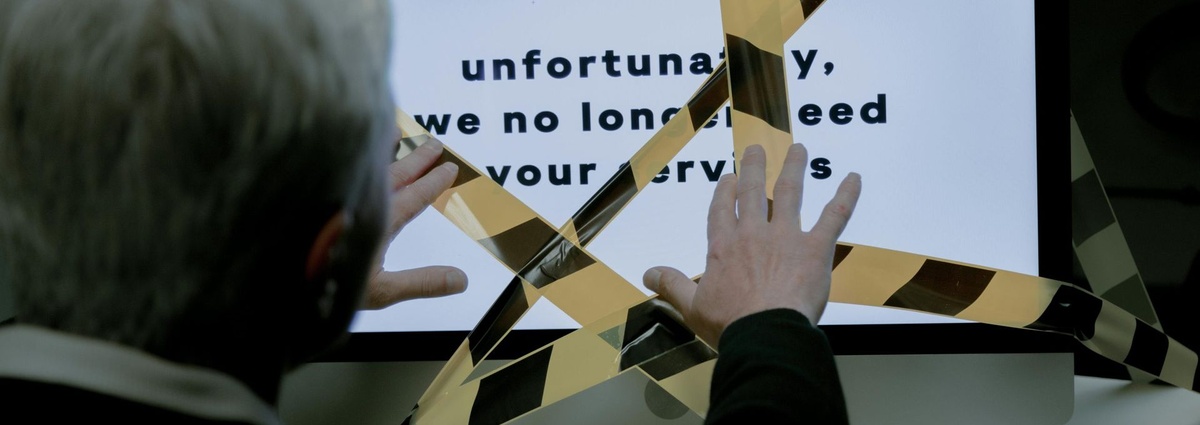
Designing Beyond the Digital Default
Microaggression in design refers to subtle issues occurring everyday while intarcting with physical or digital interfaces, creating extra barriers especially for minorities and marginalised groups. Depending on factors such as gender, language, or race, people might have to spend more effort and face more challenges on digital spaces. For instance, while filling out an online form, women or gender minorities may have to scroll down the list where ‘male’ is set as the default, if their gender is included at all. The design choices behind these exclusionary interfaces are not necessarily intentional, but they often come from the default system (of thinking), unconsciously influencing designers. This design flaw can create, maintain or intensify harm, exclusion and social inequality. In this programme we aim to explore how more thoughtful digital experience design choices can not only support current users, but also create a path for future designers to design more inclusive and accessible systems. We will also examine how policy has (or has not) prevented severe consequences of the current design practices in the digital world, and how it should be improved to address these challenges more effectively.
We are committed to making the content of this program accessible for everyone. If you have specific accessibility needs, please let us know in advance, and we will do our best to accommodate your request.
Please contact shahrzad.rezaeibami@dezwijger.nl about your request, before the program, to give us time to arrange the necessary support.
Lisanne Buik is the founder of Gracious AI, an ethical AI design agency that works with organizations and public institutions on the governance, ethics, and design of AI systems, focusing on human agency, ecological resilience, and long-term societal impact. Her PhD research develops the GRACE model as a practical framework for diagnosing and aligning human-AI collaboration inside organizations. Based in Amsterdam, Lisanne speaks internationally on the always emerging field of AI.
Peter van Waart, is senior lecturer Communication & Multimedia Design at the Rotterdam University of Applied Sciences since 2005 and researcher Smart and Inclusive Society at research centre Creating 010. His focus is on values-driven participatory design methods for meaningful technology in the urban domain. Peter initiated the Global Service Jam Rotterdam, the Rotterdam GovJam, the International IoT Day Rotterdam, and Digital Social Innovation Lab. He (co-)initiated Rotterdam Open Data and Participatory City Making, and Smart & Social Fest. Currently, he’s co-developing the Social AI Lab Rotterdam and the Katoenhuis Immersive Experience Lab. As ambassador of higher vocational education and practice-oriented research, he participates in networks such as City Deals (Smart City, AI), Future Society Lab, South Holland Immersive Network & Ecosystem, Network Digital Inclusion, and Rotterdam Citiverse.
Mayra Kapteijn is a social psychologist, designer, and the founder of Doodler, a Dutch product that turns clinical notes into visual storyboards for mental healthcare. Her work is grounded in the idea that healthcare should organise itself around the client, rather than the reverse. She views that the high literacy defaults of most healthcare interactions quietly exclude the people who need healthcare the most. With Doodler, she has built a simple but bespoke platform that make shared decision-making possible.
Kimberly Brinkhuis: I’m convinced that design is for anyone independent of your users: ability, disability, energy, knowledge, time, budget, language, age, etc. I strive daily for universal design that’s: usable, inclusive, divers, ethical, human-centered, honest, sustainable, etc. Through inclusive research and user tests that zoom in on the different “needs” users have, as every user has the same “want” to use a product or service. I say yes to accessibility, inclusivity and universality at the core of the design and research process everyday.
My story is that I was a sighted graphic designer, and now am a blind universal & meaningful tactile designer and an UX researcher.
I have a huge love for light, due to what I still see, but also my love for the color yellow and the god of light, art and honesty: Apollo-Phoebus.
Lennart Jan Reitsma: As a residential counselor at Bartimeus, I gained valuable work experience in supporting people with visual and intellectual disabilities. This experience has only strengthened my passion for working with people with disabilities and has inspired me to continue to strive for their inclusion and accessibility in our society. Hence why I now work as a UX researcher at Stichting Accessibility (part of Bartimeus). I believe it’s of great importance to involve people with disabilities in user research.