Low-profile and low-energy autonomous networking with Reticulum
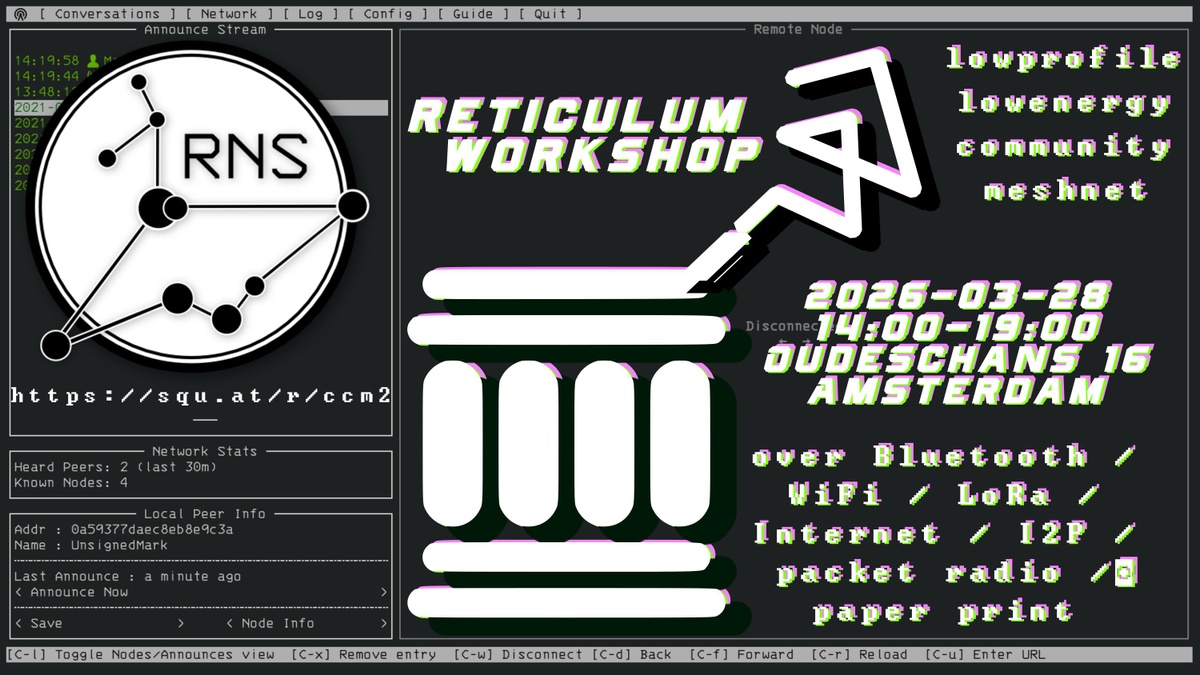
TL;DR: the March workshop is about testing the mesh network with mobile phones (over Bluetooth, WiFi, and LoRa frequencies/protocols), building infrastructure nodes, browsing and making “mu” websites, and hopefully trying out how to run the entire protocol stack on single microcontrollers (with microreticulum).
-----------------------------------------------------------------------------------------------------------------
Running your own communications infrastructure has obvious benefits. We live in a world of increasing digital censorship, and are rarely completely in charge of our communications. Even if we choose to use "better" alternatives to WhatsApp, Instagram, etc., we are still always completely reliant on the one underlying network, i.e. "The Internet". With the push of a button, "The Internet" may all of a sudden become unavailable. In places with oppressive regimes, this has not been uncommon. In the current political climate, it would not be surprising if any political system all of a sudden became repressive.
In this workshop, we will explore the possibilities for setting up a decentralized off grid communications system using the Reticulum communication protocol stack. We choose to focus on Reticulum because it is designed for heterogeneous networks built from various cheap devices, to be deployed in a bottom up way by small communities. More information is found here: https://reticulum.community/
The mesh network stack runs on various platforms. You can run it on your desktop, your home server, your mobile phone. In the workshop, we will focus on using Reticulum on three scales: (1) as a Bluetooth network for mobile phones messaging in small groups; (2) building some standalone nodes, based on a low power ARM board, that you we can deploy around Amsterdam to build out an autonomous communication infrastructure; (3) and we will also look into connecting cities with more long-range radio links.
Operating the network stack on various scales is possible because it can run on top of different transport layers. It can run on normal IPv4 networks. However, for us the interesting part is that it also runs on high latency, low bandwidth radio links. These can be Internet of Things networks like LoRa, Bluetooth networks made of mobile phones, WiFi access points or packet radio systems using cheap handheld VHF radios. (One such radio is the infamous programmable Baofeng UV-5R.)
We will look at some applications that were build on top of the Reticulum communication protocol stack. There is a simple graphical chat application called Meshchat (https://github.com/markqvist/reticulum-meshchat) that can be run locally on your computer. There is also a BBS style forum implementation, called Nomadnet (https://github.com/markqvist/NomadNet) that also works over the terminal on servers. Finally, there is a user-friendly Android mobile phone app called Columba (https://github.com/torlando-tech/columba). The current services include text, photo, voice and video messaging – as well as audio calls and publishing website-like content called “mu sites” in the “micron format”. No prior experience is needed, but you might benefit from looking into the Reticulum Manual that is available from the website: https://reticulum.network/manual/Reticulum%20Manual.pdf
The March workshop is hosted by Internet Archive Europe and facilitated by the critical infrastructure lab.
The next (April 2026) workshop will be in Den Haag, hosted by the Anarchist Library Opstand:
https://radar.squat.net/en/event/den-haag/anarchistische-boekenplek-opst...