From Breath to Body Politics
Why do we like listening to some people more than others? In a world suffused by speech – of politicians, influencers, salespeople and pundits alike – that question seems more relevant than ever. Join us for a panel conversation on how the power of a ‘good voice’ has been shaped and re-shaped in the last two centuries.
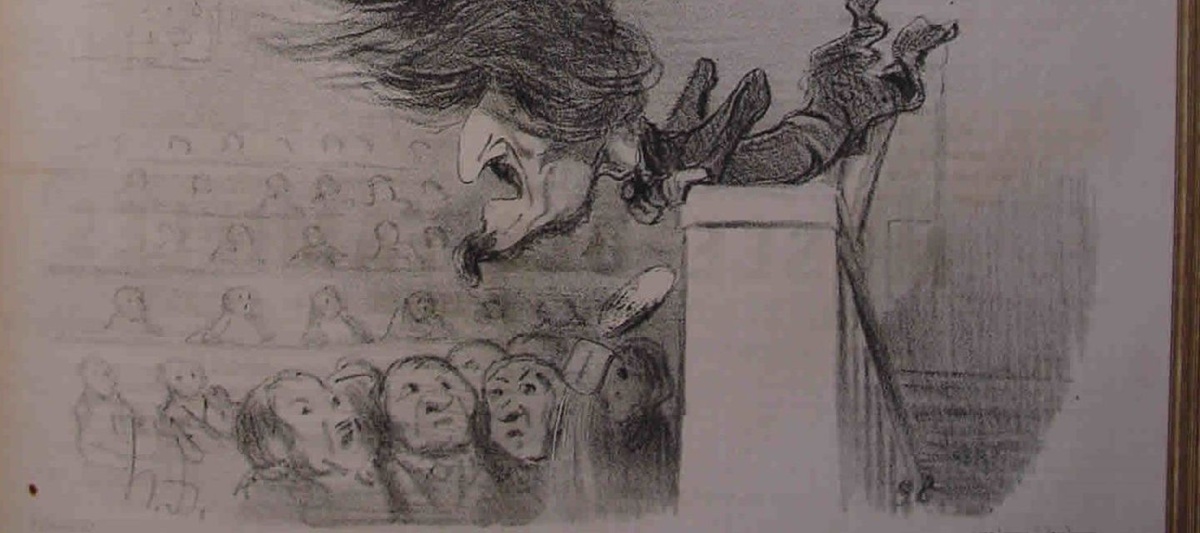
In her new book Speaking, Stammering, Singing, Shouting (A Social History of the Modern Voice), Josephine Hoegaerts explores how speaking became a central aspect of modern political and professional lives, and how our expectations of speakers were shaped in the nineteenth century. In this period of democratization, new mass media, and significant social and economic shifts, speaking well became an important skill for a growing group of people – including workers, women, and children.
Learning how to raise one’s voice, address a crowd and sound pleasant while doing so was not easy, however, and required these speakers to bend their minds, tongues and bodies to a range of stringent and often confusing norms. Doing so could be both stifling and liberating: learning to speak well often meant suppressing seemingly natural tendencies, but it could also open the door to emancipation. The sound of these modern forms of speech and its educational, political and cultural consequences still echo in our ears today.
We will discuss the emancipatory promises as well as the normative frameworks of modern voice and speech in a panel conversation including experts on oracy education, the politics of sound, and the history of the body.
About the speakers
Josephine Hoegaerts is Professor of European Culture after 1800 at the University of Amsterdam’s European Studies group, where she explores the histories of speech and sound in modern democracies. Her research investigates topics from citizenship and political participation to the embodiment of authority in nineteenth-century Europe.
Tom Wright is Associate Professor in Rhetoric at the University of Sussex. Focusing on nineteenth century Britain and America, he writes mostly about political language, education and spoken communication. He lead the project Speaking Citizens, leading a team of social science and humanities researchers across multiple institutions to ask difficult questions about speaking and listening education. Most recently, he published Oracy, the Politics of Speech Education (Cambridge University Press 2005).
Willemijn Ruberg is Professor of Cultural History and head of the Cultural History group at Utrecht University. Her research interests include the modern history of gender, sexuality, emotions, law, knowledge, forensic expertise and the body, as well as cultural theory. Among other publications, she published History of the Body (Palgrave MacMillan 2020). Currently she is working on a book discussing the cultural history of the right to bodily integrity in modern Europe. Also, she is co-editor of the Oxford Handbook of the History of the Modern Body (2027).
Houssine Alloul (moderator) is Assistant Professor of Modern Global History at the University of Amsterdam, and co-PI of the project “Sound Affairs: Sonic Histories of Foreign Relations, 1700-1900”. His work focuses on international relations in Modern Europe and the Late Ottoman Empire, and looks in particular at how small power diplomacy, the global circulation of capital, and transnational sociabilities interlaced.