CiNEMERCATOR - Federico Fellini Nights of Cabiria 1957
Filmlover,
Merthe Voorhoeve,
Andreas van Riet,
Maaike Hasselaar
& Elisabeth van Vliet,
each are programming 1 precious film per month. That's 4 precious films per month!
CiNEMERCATOR
doors open 19:00
start 20:00
ticket 3€
8-4
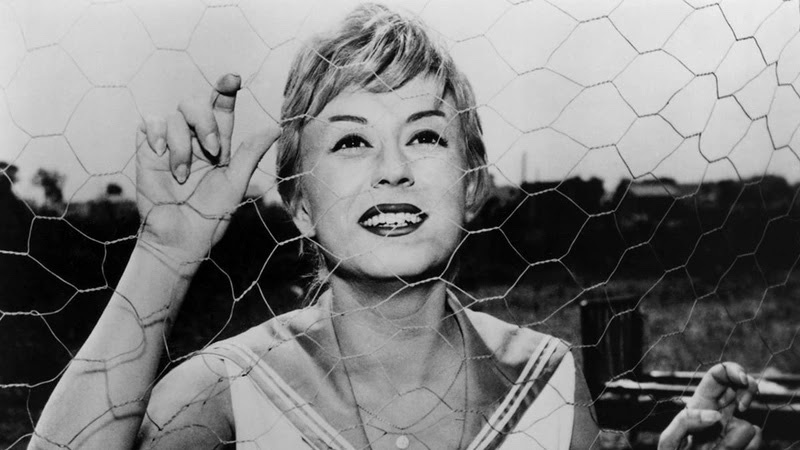
Federico Fellini Nights of Cabiria 1957
Few films in the work of Federico Fellini feel as suspended between worlds as Nights of Cabiria. It stands at a precise, almost fragile juncture in his career: after the breakthrough humanism of La Strada and Il Bidone, but before the baroque, self-reflexive spectacles of La Dolce Vita and 81⁄2. It is, in that sense, both culmination and threshold: the last of Fellini’s neorealist-adjacent works, and the first to hint at the inward, dreamlike cinema to come. The world bends- slightly- toward the inner life of the character, reality is no longer fixed; it becomes permeable to feeling, to memory, to something like... grace?
The film follows Cabiria, a Roman sex worker played with extraordinary tensile energy by Giulietta Masina. She is small, stubborn, indignant and perpetually exposed to humiliation. Men steal from her, deceive her, discard her. Yet the film does not unfold as a catalogue of suffering, instead, it becomes a study in persistence; less the endurance of hardship than the refusal to relinquish hope.
Elisabeth's choice
15-4
Maren Ade TONI ERDMANN 2016
Some films announce their strangeness immediately; Toni Erdmann takes its time. It begins in a register that feels almost over-familiar: a father, Winfried, mildly anarchic, drifting through small practical jokes; a daughter, Ines, professionally composed, stationed deep inside the antiseptic machinery of corporate consultancy in Bucharest. The setup suggests a generational comedy, perhaps even a reconciliation narrative. What unfolds instead is something more elusive; less a story than a slow destabilisation.
What moves between father and daughter is difficult to name. It is not reconciliation, not recognition exactly. Something passes, occasionally, like a current that neither of them can hold. He insists, in his way, on the possibility of something else. She resists, or cannot quite follow. And yet, at times, they seem to meet in a what seems like a shared uncertainty.
It's remarkable how little the film insists on meaning. Its coolness lies not in detachment, but in its refusal to overdetermine what we are seeing. The absurd does not redeem; it exposes. Ade avoids transcendence. She trusts duration, awkwardness, the intelligence of its viewer and leaves us- like its characters- negotiating the space between performance and presence, unsure where one ends and the other begins...
Merthes' choice
22-4
Danny Boyle TRAiNSPOTTING 1996
Trainspotting, directed by Danny Boyle, carried- and quietly undone- by young Ewan McGregor, is about a group of friends in Edinburgh getting high, ripping each other off, talking shit, killing time. One of them half-trying to leave without really knowing what leaving even is.
It’s not built like a rise-and-fall or a warning, it runs on momentum. The characters already know the deal, the film doesn’t waste time pretending they don’t. What it locks into is that strange zone where nothing is hidden, but nothing changes either. It trusts style. Not as decoration, but as a way of thinking. The film feels like it’s been rewired to match the headspace it’s inside.
That’s why it stuck with people. It didn’t stand outside and explain a generation- it sounds like it. Fast, ironic, a bit smug, already over everything. And then, without announcing it, it lets that tone wear thin...
Maaikes' choice
Do you want to receive our