🎬 Windows, Beautifully Rendered – Machinima
What if movies shot in digital worlds tell us more about our world and how we conceive it than the reality surrounding us? What we see on screen in this program was never in front of a camera. These images were born digital: built, simulated and rendered by a computer. This evening is all about machinima, films made inside video games, and the works we’re showing use game worlds to look at the world, and at what it takes to make one look real.
Harun Farocki’s Parallel I-III examines how game worlds are constructed, while Total Refusal’s How to Disappear and Hardly Working wander through game environments, looking at what usually goes unnoticed and turning it into a critique of our society.
This is the first evening in a series of screenings on digital born images, organized in collaboration with the Institute of Network Cultures. Next up: desktop cinema.
Parallel I
Harun Farocki | 2012 | 16’ | EN subtitles
Parallel I opens up a history of styles in computer graphics. The first games of the 1980s consisted of only horizontal and vertical lines. This abstraction was seen as a failing, and today representations are oriented towards photo-realism.
Parallel II and Parallel III
Harun Farocki | 2014 | 16’ | EN subtitles
Parallel II and Parallel III seek out the boundaries of the game worlds and the nature of the objects. It emerges that many game worlds take the form of discs floating in the universe – reminiscent of pre-Hellenistic conceptions of the world. The worlds have an apron and a backdrop, like theatre stages, and the things in these games have no real existence. Each of their properties must be separately constructed and assigned to them.
How to Disappear Working
Total Refusal | 2020 | 21’ | EN subtitles
How to Disappear is an anti-war movie in the true sense of the word, searching for possibilities for peace in the most unlikely place of an online war game. It’s a tribute to disobedience and desertion – in both digital and physical-real warfare. Shot in the picturesque war landscapes of Battlefield V, the hyperreal graphics become the backdrop for an essay-like narrative. The film revolves around the history of deserters – a part of human history, which has hardly been illuminated. Performances and creative interventions explore the scopes and limits of the audiovisual entertainment machine.
Hardly Working
Total Refusal | 2022 | 20’ | EN subtitles
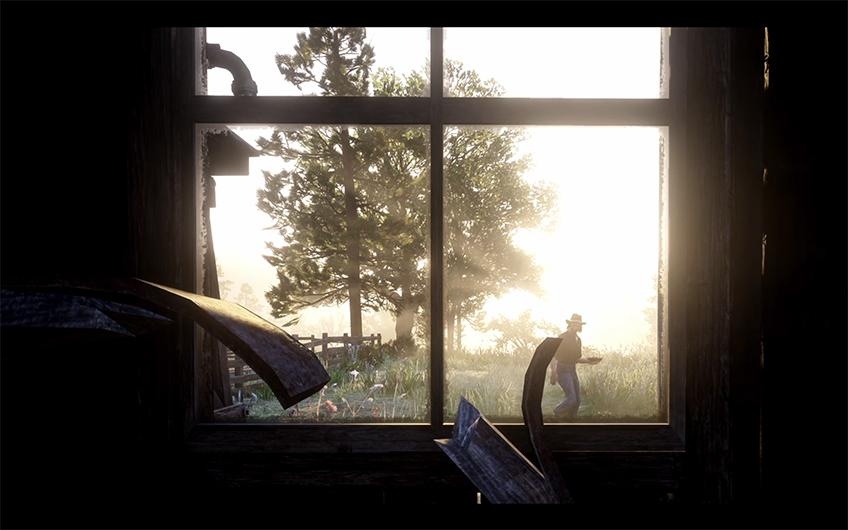
Hardly Working gives priority to characters that normally fade into the background of video games: NPCs. NPCs are non-playable characters that populate hyper real worlds to create the appearance of normality. Usually these digital extras play no major role in the story of the game. Here a laundress, a stableman, a street sweeper, and a handyman are the four main characters of this film. With ethnographic precision, the film observes their daily work: a rhythm composed of loops that makes them work daily and tirelessly. Their work neither results in a product, nor does it change anything about their status quo. In light of Hannah Arendt description of ‘animal laborans’ – in contrast to the acting subject –, the NPCs as individuum are an exaggeration as their work performance actually manifests their status.
Here, work becomes a pure performance, carried out for its own sake. NPCs perform so-called surrogate actions that generate no social benefit. These actions are performed and enforced for the sake of appearances to ensure a social order.
NPCs are digital Sisyphus machines that have no perspective of breaking out of their activity loops. In the moments when the algorithm of their existence shows inconsistencies, the NPCs break out of the logic of total normality, display their own faultiness, and appear touchingly human.