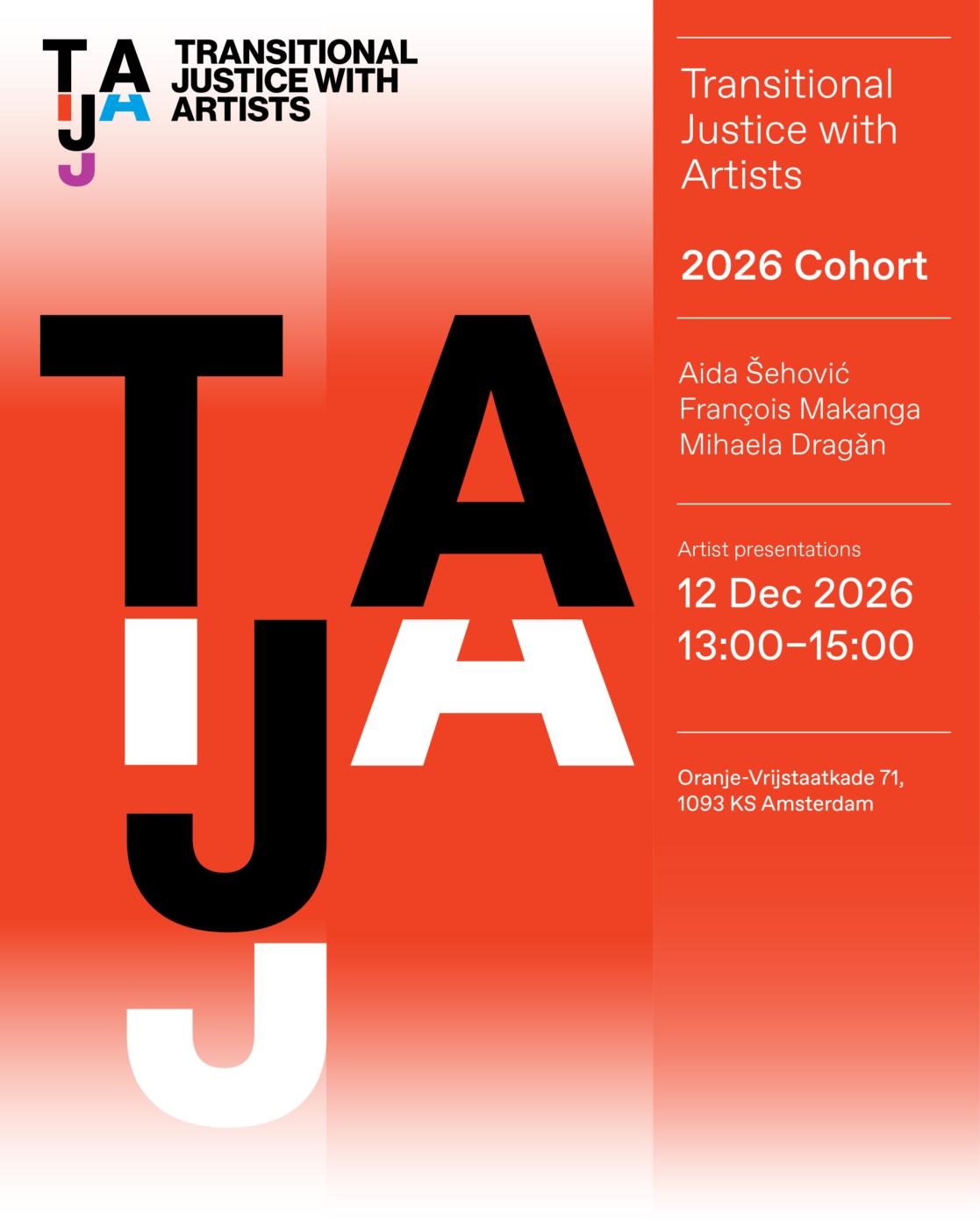
Presentation: Transitional Justice with Artists Cohort 2026
Through grant fellowships, residencies, research groups and public programmes, TJA explores how artistic methodologies can contribute to processes of truth-telling, memory, recognition, repair and accountability, while expanding the possibilities of transitional justice beyond established legal and institutional frameworks The three fellows selected for the 2026 Cohort are hosted at Framer Framed for a week-long residency as part of the TJA programme. This public moment is the culmination of their residency period and an opportunity for the wider audience to get a glimpse into their artistic practices and research and explore the possibilities of artistic practices in connection to transitional justice processes.
Please sign up here.
The three TJA 2026 Cohort Fellows are:
Aida Šehović (Bosnia & Herzegovina) with the ŠTO TE NEMA Foundation. ŠTO TE NEMA Foundation is an initiative resisting the normalisation of genocide through collective healing and public mourning. It operates as a participatory memorial initiative responding to the denial of the 1995 Srebrenica Genocide—in which more than 8,372 Bosnian Muslim men and boys were systematically killed during the Bosnian War—and to the wider failure of post-conflict societies to hold onto accountability once the trials end. At the centre of its artistic practice is the fildžan, a small, handleless porcelain cup used to serve traditional Bosnian coffee. The initiative transforms a private, everyday ritual into a shared act of collective remembrance and civic responsibility.
François Makanga (Belgium) with Cultural Marronage in the Public Sphere, an initiative confronting colonial erasure through theatrical walks and institutional interventions to advance historical accountability and collective truth-seeking. Aiming to interrogate the legacies of colonialism and how they affect memory culture, Brussels-based mediator François Makanga established the initiative Cultural Marronage in the Public Sphere. Through immersive, theatrical walks through Brussels, the project unmasks the colonial histories embedded in monuments, while temporary labels (cartels éphémères) subvert official museum exhibitions by injecting contemporary African commentary, particularly Congolese resistance and the histories of colonized women, entirely invisible within the shared cultural and civic imagination.
Mihaela Dragǎn (Romania) with Giuvlipen Theatre Company, an initiative blending theater, film, and Roma Futurism—a framework fusing cultural heritage with technology and witchcraft—to dismantle systemic anti-Roma racism. Co-founded by Mihaela Drăgan, Giuvlipen Theatre Company in Bucharest pushes back against Roma erasure through bold, experimental methodologies. This includes Roma Futurism, an artistic vision that de-centers whiteness and fuses cultural heritage with technology and witchcraft. Using joyful performance, music, and fashion, the collective challenges deep-seated stereotypes to rewrite the present and imagine the future. It wishes address structural biases and institutional barriers, forced displacements and restrictions on spiritual practices, highlighting the living complexities of the Roma communities.