Clouds of thought surrounding you
For nearly three centuries, the string quartet has exerted an almost irresistible pull on many composers. Why? While it lacks the colorful splendor of the orchestra and the solo virtuosity of the piano, it is an instrumental combination that is extremely flexible and concise, often enticing composers to write their most authentic works.
Tonight, the Janos String Quartet presents a small selection from the repertoire: in addition to a quartet by Haydn (the inventor of the genre) and one by Bartók (one of the leading quartet composers of the last century), a new work by Ivo van Emmerik.
In a letter dated April 5, 1784, to his publisher Artaria, Haydn wrote that he was working on a series of "very short" quartets, each with only three movements, for a Spanish patron. Either he abandoned the commission, or the quartets have been lost. But it is not inconceivable that the freestanding Quartet, Op. 1, was commissioned. 42 from 1785 contains music from the lost or aborted Spanish project.
Van Emmerik about his quartet: “It began when I found some old sketches of a work I had never quite finished. Revisiting them, I was confronted with ideas from long ago and had to find a way to rearrange their elements into a new composition. I was reminded of Lee Krasner, who cut up earlier drawings of herself and her late husband, Jackson Pollock, and created new collages from them. Old and new ideas are vaguely interwoven, yet the interrelationships, evident or hidden in all six movements, create a memory game, making this string quartet a metaphor for the unusually long time it took to complete.”
Béla Bartók’s String Quartet No. 3 was written in Budapest in September 1927. It is often suggested that Bartók was inspired by a performance of Alban Berg’s Lyric Suite (1926).
The quartet is Bartók's shortest, written as a single, continuous whole, consisting of a first movement (slow), a second movement (fast, with influences from Hungarian folk music), a return of the first movement, and a coda, which is a return of the second movement. Harmonically and contrapuntally complex, the work explores a number of coloristic techniques, including sul ponticello (playing with the bow as close as possible to the bridge), col legno (playing with the wood of the bow instead of the hairs), and glissandi (sliding from one note to another) that frequently appear in later quartets.
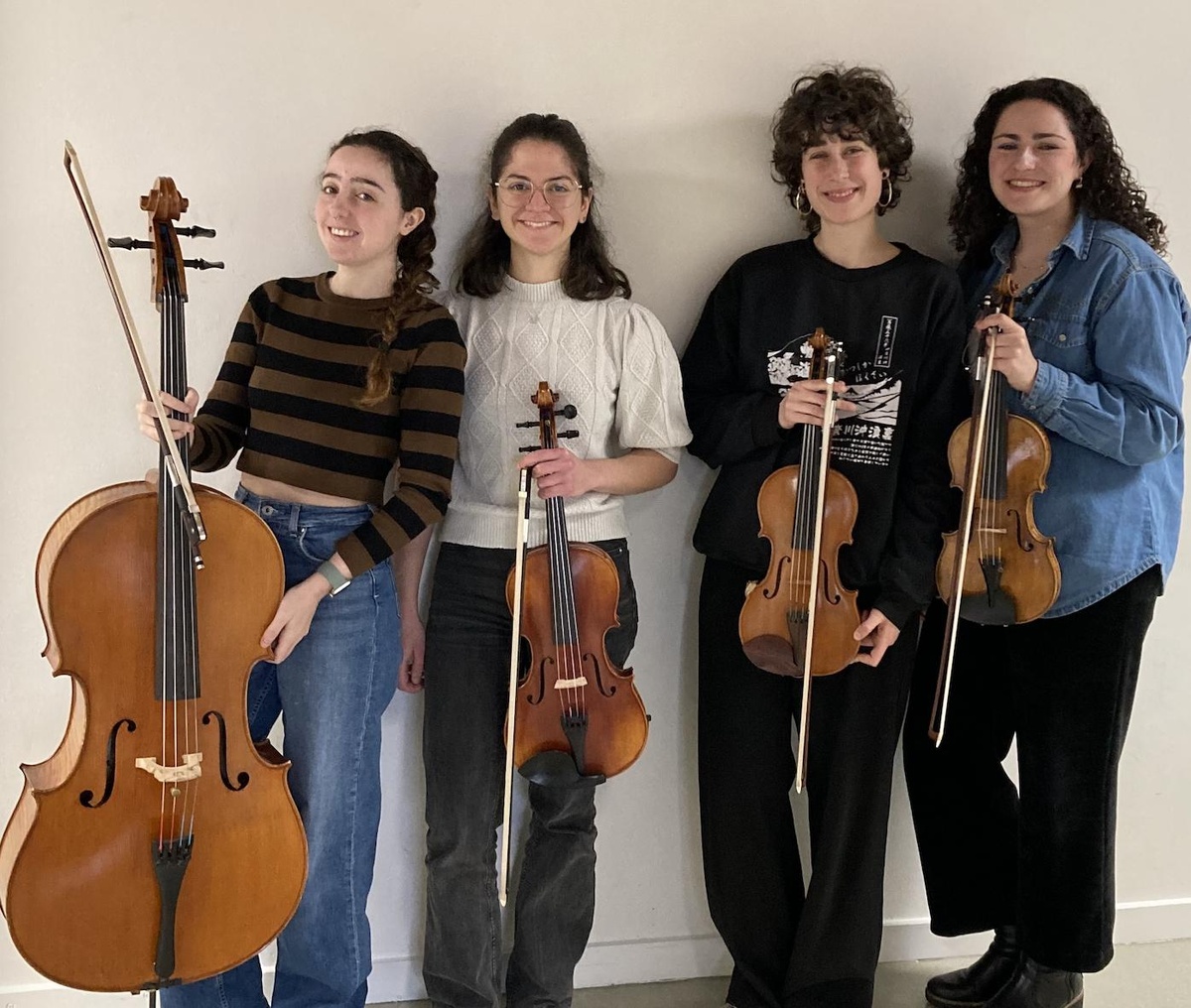
The Janos Quartet was founded in 2024 following the preparation of Béla Bartók's String Quartet No. 3, which they performed in June of that same year, marking the beginning of their collaboration. Since then, they have continued to explore the Classical and Romantic repertoire, deepening their sound and communication as an ensemble. They have attended masterclasses with Sarah Kapustin and Roeland Jagers, who have contributed to their artistic development. They also share a strong interest in contemporary music, which plays a vital role in their identity and future projects.
JANOS STRING QUARTET:
Laura Torres Morales, violin
Mireia Escobar Ortega, violin
Eider Armendariz Cividian, viola
Julia Misas Santín, violoncello